

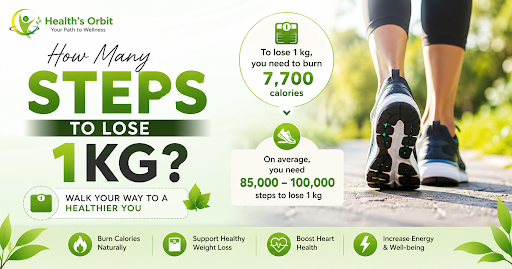
If you are wondering how many steps to lose 1 kg, the straightforward answer is: approximately 100,000 to 150,000 steps in total. That number sounds large, but spread across days and weeks it is entirely achievable without a gym, equipment, or a strict diet plan.
Walking is one of the most underrated fat loss tools available. It is low impact, free, sustainable, and backed by decades of clinical research. Understanding the math behind it helps you set realistic goals and stay consistent.
The Science Behind 1 kg of Fat
To lose 1 kg of body fat, you need to create a caloric deficit of approximately 7,700 calories. This figure is one of the most well-established principles in clinical nutrition and is cited by the National Institutes of Health (NIH), Harvard Health, and the Mayo Clinic.
Why 7,700 and not 9,000? Pure dietary fat contains about 9,000 calories per kg, but stored body fat is not pure fat , it also contains water, protein, and connective tissue. When these are factored in, the effective energy value drops to around 7,700 kcal per kg (Hall, 2008; Wishnofsky’s rule, ScienceDirect, 2012).
Key principle: 1 kg of body fat ≈ 7,700 calories of deficit needed.
How Many Calories Does 1,000 Steps Burn?
The calories burned per 1,000 steps depend on your body weight and walking pace, but a reliable average is:
| Body Weight | Calories per 1,000 Steps |
| 55 kg (121 lbs) | ~35–40 kcal |
| 70 kg (154 lbs) | ~45–50 kcal |
| 85 kg (187 lbs) | ~55–60 kcal |
| 100 kg (220 lbs) | ~65–70 kcal |
Source: Compendium of Physical Activities; InBody USA; OmniCalculator
On average, most adults burn 40–60 calories per 1,000 steps at a moderate walking pace of 3–4 mph.
How Many Steps to Lose 1 kg: By Body Weight
Using the 7,700-calorie rule and the calorie-per-step estimates above, here is how many steps to lose 1 kg for different body types:
| Body Weight | Calories per 1,000 Steps | Steps Needed to Lose 1 kg |
| 55 kg | ~38 kcal | ~202,600 steps |
| 70 kg | ~47 kcal | ~163,800 steps |
| 85 kg | ~57 kcal | ~135,100 steps |
| 100 kg | ~67 kcal | ~114,900 steps |
Estimates based on 0.04–0.07 kcal/step depending on weight. Individual results will vary.
The heavier you are, the more calories each step burns , which means fewer total steps are needed to hit the 7,700-calorie deficit. A 100 kg person needs roughly 115,000 steps to lose 1 kg from walking alone, while a 55 kg person needs closer to 200,000 steps.
How Long Will It Take?
This is where consistency becomes the deciding factor. If you walk 10,000 steps per day , the most commonly recommended daily target , here is how long it takes to accumulate enough steps to lose 1 kg:
| Daily Steps | Calories Burned/Day (70 kg) | Days to Lose 1 kg | Weeks |
| 5,000 steps | ~235 kcal | ~33 days | ~5 weeks |
| 7,500 steps | ~352 kcal | ~22 days | ~3 weeks |
| 10,000 steps | ~470 kcal | ~16 days | ~2.3 weeks |
| 12,000 steps | ~564 kcal | ~14 days | ~2 weeks |
| 15,000 steps | ~705 kcal | ~11 days | ~1.6 weeks |
Based on the average 70 kg adult. Calculations use the 7,700 kcal/kg fat rule.
At 10,000 steps per day, a 70 kg person can expect to lose roughly 1 kg of fat every 16 days from walking alone , without changing their diet. Combine that with a modest calorie reduction, and the timeline shortens significantly.
Factors That Affect Calorie Burn per Step
Not every step burns the same number of calories. Several variables influence how efficiently your body uses energy while walking:
Body weight ;heavier individuals burn more calories per step because more energy is needed to move a larger body mass (NIH, PMC 2020).
Walking speed ; brisk walking at 4 mph has a MET value of approximately 5.0, compared to 3.5 for a leisurely 3 mph pace. Higher MET = more calories burned per minute (Compendium of Physical Activities).
Terrain and incline ; walking uphill or on uneven surfaces increases energy expenditure compared to flat pavement. A 10% incline can increase calorie burn by up to 25%.
Age and fitness level ; metabolic rate naturally slows with age. Less fit individuals may burn slightly more calories for the same effort due to lower cardiovascular efficiency.
Step length ; taller people with longer strides cover more distance per step, burning slightly more calories per 1,000 steps compared to shorter individuals.
Daily Step Goals for Weight Loss
Research from multiple large-scale studies offers clear guidance on how many daily steps support meaningful weight loss:
| Daily Step Count | Weight Loss Benefit |
| Under 4,000 steps | Minimal considered sedentary |
| 4,400–6,000 steps | Reduces mortality risk; modest fat burn |
| 7,000–7,500 steps | Critical threshold significant health + weight benefit (JAMA Network Open, 2021) |
| 8,000–10,000 steps | Optimal range for fat loss; lower body fat % (Scientific Reports, 2022) |
| 10,000+ steps | Maximum benefit zone for active weight loss |
A landmark study published in JAMA Network Open (2021) followed over 2,000 adults for 11 years and found that 7,000 steps per day was a critical inflection point for health outcomes. A 2022 analysis in Scientific Reports confirmed that adults averaging 8,000–9,000 steps per day had significantly lower body fat percentages than those walking fewer than 5,000.
The NIH recommends a daily caloric deficit of 500–1,000 kcal as a safe and sustainable rate for losing 0.5 -1 kg per week , walking is one of the cleanest ways to create part of that deficit.
Tips to Maximize Weight Loss from Walking
Walking consistently is the foundation, but these strategies help you get more out of every step:
- Walk briskly, not leisurely. A pace of 4-5 mph burns significantly more calories than a slow stroll. Aim to maintain a pace where you can talk but feel slightly breathless.
- Add inclines. Choosing hilly routes, using a treadmill incline, or climbing stairs dramatically increases calorie burn per step without adding more time.
- Walk after meals. A 15-20 minute walk after eating improves blood sugar regulation and contributes to your daily step total naturally.
- Split your steps. You do not need to walk 10,000 steps in one go. Three walks of 3,000–4,000 steps each are equally effective and easier to sustain.
- Track consistently. Use a pedometer, smartphone app, or smartwatch. People who track steps consistently walk an average of 2,500 more steps per day than those who do not (multiple behavioural studies).
- Pair with a mild calorie deficit. Walking alone can achieve 1 kg loss, but combining it with a 200–300 kcal/day dietary reduction cuts the timeline roughly in half.
Conclusion
So, how many steps to lose 1 kg? The science gives us a clear range: approximately 100,000 to 200,000 total steps, depending on your body weight, pace, and terrain. For an average 70 kg adult walking at a moderate pace, that comes to roughly 163,000 steps ,or about 16 days of 10,000 steps per day.
The key insight is that losing 1 kg of fat requires a 7,700-calorie deficit, and walking is one of the most accessible, sustainable, and joint-friendly ways to create that deficit over time. You do not need to hit 10,000 steps on day one. Start at your current baseline, add 1,000-2,000 steps every week, and let the cumulative effect do the work.
Walking combined with a modest dietary adjustment is not just effective , it is one of the most clinically supported long term weight management strategies available.
Scientific Sources
- Hall, K.D. (2008). “What is the required energy deficit per unit weight loss?” International Journal of Obesity. Establishes the 7,700 kcal/kg fat rule.
- Wishnofsky, M. (1958); cited in ScienceDirect (2012). “Energy content of weight loss: kinetic features during voluntary caloric restriction.” Metabolism, ScienceDirect.
- Paluch, A.E. et al. (2021). “Daily steps and all-cause mortality: a meta-analysis of 15 international cohorts.” — JAMA Network Open. Identifies 7,000 steps/day as the critical health threshold.
- Ryu, S. et al. (2022). “Association between daily step count and body fat percentage.” — Scientific Reports. Confirms lower body fat in adults walking 8,000–9,000 steps/day.
- NIH Clinical Guidelines on Obesity. “Rate of weight loss can be predicted by patient characteristics.” — PMC/NIH (PMC3447534). Recommends 500–1,000 kcal/day deficit for 0.5–1 kg/week loss.
- Compendium of Physical Activities. MET values for walking at various speeds used to calculate calorie expenditure per step.
- InBody USA. “How many calories does walking 10,000 steps burn?” Provides calorie-per-step estimates by body weight.
- BodySpec (2026). “How many steps to lose weight?” Synthesizes controlled trial data and CDC energy-expenditure formulas.
This article is for informational purposes only. Consult a qualified healthcare provider or registered dietitian before making significant changes to your activity level or diet.