

Why Your Back Deserves Better
Back pain is one of the most common health complaints in the world. Millions of people wake up every morning feeling stiff, sore, or uncomfortable in their lower, middle, or upper back. While medication can provide temporary relief, it rarely addresses the root cause. That is exactly why more and more people are turning to yoga. The best yoga poses for back pain offer a natural, holistic, and sustainable path to recovery one that strengthens the muscles, improves flexibility, and restores balance to the entire spine.
This article walks you through everything you need to know: how yoga works for back pain, which poses are most effective, what benefits to expect, possible precautions, and who can benefit the most. Whether you are a complete beginner or someone returning to movement after an injury, this guide is designed with you in mind.
How Yoga Helps Relieve Back Pain
Yoga is far more than stretching. It is a mindful movement practice that combines breath, alignment, and body awareness. When applied consistently, yoga targets the exact areas that contribute to back pain, tight hip flexors, weak core muscles, compressed spinal discs, and poor posture habits.
The best yoga poses for back pain work by gently lengthening the muscles along the spine, releasing built-up tension, and improving circulation to the discs and surrounding tissues. They also activate the deep stabilizing muscles around the lumbar spine, which are often underused in people who sit for long periods. Over time, regular practice retrains the body to move more efficiently and with less strain.
Additionally, yoga triggers the parasympathetic nervous system the body’s rest-and-digest mode. This reduces cortisol levels and helps break the cycle of stress-induced muscle tension that so often worsens chronic back pain.
Quick Reference: Best Yoga Poses for Back Pain at a Glance
Before diving into the details of each pose, here is a quick overview of the most effective options, their difficulty level, and their primary benefit.
| Yoga Pose | Level | Primary Benefit | Recommended Duration |
| Cat-Cow Stretch | Beginner | Spinal flexibility | 5–10 min |
| Child’s Pose | Beginner | Lower back relief | 3–5 min |
| Downward Dog | Beginner–Inter. | Full back stretch | 5 min |
| Sphinx Pose | Beginner | Lower back strength | 3–5 min |
| Pigeon Pose | Intermediate | Hip & back release | 5 min each side |
| Bridge Pose | Beginner | Core & glute strength | 5 min |
| Supine Twist | Beginner | Spinal decompression | 5 min each side |
The Best Yoga Poses for Back Pain Explained in Detail
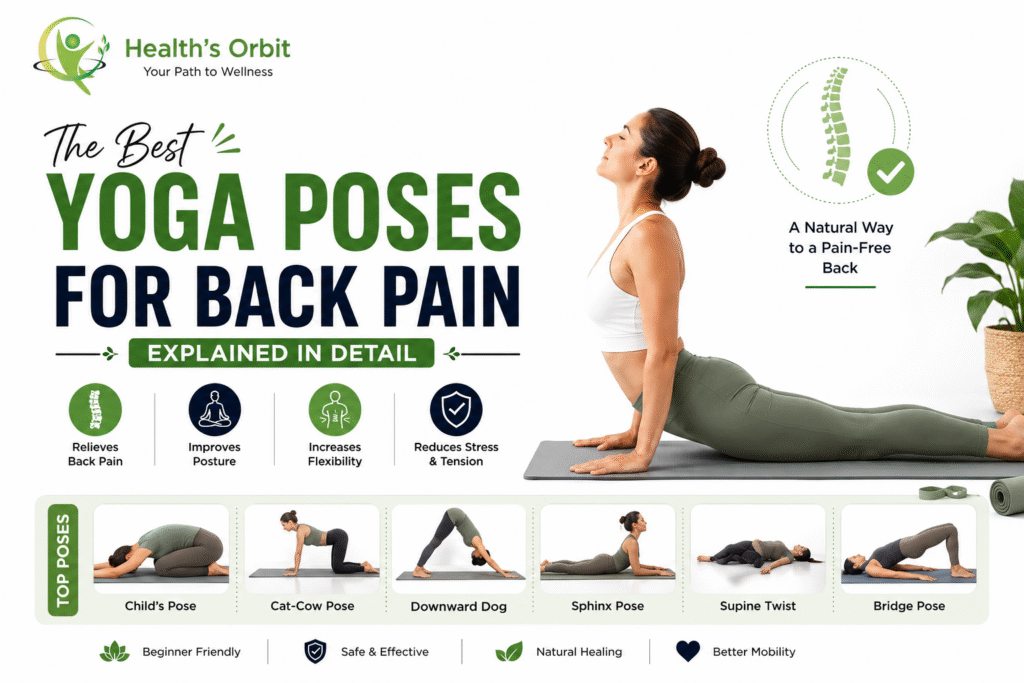
1. Cat-Cow Stretch (Marjaryasana-Bitilasana)
The Cat-Cow Stretch is arguably the most accessible entry point for anyone dealing with back discomfort. It involves moving between two positions on all fours arching the back upward like a frightened cat and then dipping it downward like a contented cow. This gentle flow warms up the spine, lubricates the vertebral joints, and promotes mobility from the neck all the way down to the tailbone. It is one of the best yoga poses for back pain because it can be done first thing in the morning to ease morning stiffness almost immediately.
2. Child’s Pose (Balasana)
Child’s Pose is a deeply restorative position that gently stretches the lower back, hips, and thighs simultaneously. You simply kneel on the floor, sit back toward your heels, and extend your arms forward with your forehead resting on the mat. This pose creates traction along the lumbar spine, decompressing the vertebrae and providing almost instant relief from lower back tightness. It is also a wonderful pose to return to whenever you feel overwhelmed during a yoga session.
3. Downward-Facing Dog (Adho Mukha Svanasana)
Downward-Facing Dog is a foundational yoga pose that stretches the entire posterior chain from the heels up through the calves, hamstrings, and all the way along the back. When the hamstrings and calves are tight, they pull on the lower back and cause pain. This pose addresses that tension directly. It also gently inverts the body, which takes pressure off the lumbar discs and encourages blood flow to the spinal region. Practiced correctly, it is one of the most comprehensive best yoga poses for back pain available.
4. Sphinx Pose (Salamba Bhujangasana)
Sphinx Pose is a gentle backbend that strengthens the muscles of the lower back without placing excessive strain on them. Lying on your stomach, you prop yourself up on your forearms and gently lift your chest. This pose works beautifully for people with disc issues because it promotes what physiotherapists call spinal extension, a direction of movement that can help centralize disc-related pain. It is mild, controlled, and safe for most beginners.
5. Pigeon Pose (Eka Pada Rajakapotasana)
Tight hips are a hidden driver of lower back pain. When the piriformis and hip flexor muscles are chronically tense, they rotate the pelvis and compress the lumbar spine. Pigeon Pose targets these muscles with incredible precision. By bringing one leg forward and extending the other behind you, you create a deep stretch in the outer hip and glute area. Many people feel a profound release in their lower back simply from opening the hips in this way.
6. Bridge Pose (Setu Bandhasana)
Bridge Pose builds strength in the glutes, hamstrings, and lower back all muscles that support spinal alignment. Lying on your back with your knees bent and feet flat on the floor, you lift your hips toward the ceiling while pressing your arms into the mat. This pose not only strengthens the posterior chain but also gently stretches the hip flexors, which tend to shorten from prolonged sitting. Stronger glutes and a more open front body lead to far less lower back strain over time.
7. Supine Spinal Twist (Supta Matsyendrasana)
The Supine Spinal Twist is a gentle, passive rotation that releases tension along the entire spine while also stretching the outer hips and glutes. Lying on your back, you draw one knee into your chest and guide it across the body while extending your arm in the opposite direction. This movement decompresses the lumbar vertebrae and creates space between the discs. It is especially beneficial at the end of a yoga session or before bed, as it has a deeply calming effect on the nervous system.
Key Benefits of Practicing Yoga for Back Pain
The benefits of regularly practicing the best yoga poses for back pain go well beyond simple pain relief. First and foremost, yoga improves overall spinal mobility, which tends to decrease with age and sedentary lifestyles. Greater mobility means less stiffness and a lower risk of injury during everyday movements. Second, yoga builds functional strength in the core, glutes, and back muscles, the very muscles that hold the spine in proper alignment.
Furthermore, yoga improves posture. Poor posture is one of the leading contributors to chronic back pain, particularly in office workers and those who spend extended hours at a desk. Regular practice gradually retrains the postural muscles and encourages a more upright, balanced stance. Beyond the physical, yoga reduces psychological stress, which is a documented aggravator of chronic pain. Studies have shown that mindfulness-based movement like yoga lowers pain perception and improves overall quality of life for people with persistent back problems.
Possible Side Effects and Important Precautions
While yoga is generally safe, it is important to approach it with awareness. Practicing the wrong poses or using incorrect technique can aggravate back pain rather than relieve it. Deep forward folds, for example, can worsen disc herniations. Aggressive twists can strain already inflamed muscles. Always listen to your body, and stop immediately if you feel sharp, radiating, or shooting pain.
People with specific spinal conditions such as spondylolisthesis, severe scoliosis, or recent spinal surgery should always consult a doctor or a certified physiotherapist before beginning any yoga routine. It is also worth working with a qualified yoga instructor, at least initially, to ensure that alignment is correct and modifications are used where needed. Soreness after a session is normal; pain is not.
Who Should Consider Yoga for Back Pain?

The best yoga poses for back pain are suitable for a wide range of individuals. Office workers who experience tension from prolonged sitting are excellent candidates. Older adults dealing with age-related spinal stiffness can benefit greatly from gentle, modified yoga. Athletes recovering from back injuries often use yoga as part of their rehabilitation, as it restores mobility without high impact. Pregnant women, too, can practice prenatal yoga specifically designed to ease the back strain that often accompanies pregnancy.
That said, yoga is not a one-size-fits-all solution. If your back pain is severe, sudden in onset, or accompanied by numbness, tingling, or weakness in the legs, seek medical evaluation before starting any new exercise programme. Once cleared by a professional, yoga can be a powerful and transformative tool in your recovery journey.
Conclusion: Take the First Step Toward a Pain-Free Back
Living with back pain does not have to be your permanent reality. The best yoga poses for back pain provide a gentle, effective, and empowering way to reclaim your comfort, mobility, and quality of life. From the soothing simplicity of Child’s Pose to the strengthening power of Bridge Pose, each posture serves a purpose and works synergistically with the others to heal and protect your spine.
Consistency is the key. Even ten to fifteen minutes of mindful yoga practice each day can produce meaningful results within a few weeks. Start slowly, honour your body’s limits, and gradually build your practice. Your back has carried you through everything now it is time to give it the care it truly deserves.
Frequently Asked Questions (FAQ)
Here are answers to some of the most commonly asked questions about the best yoga poses for back pain.
| Question | Answer |
| How often should I practice yoga for back pain? | Practicing 3 to 4 times per week is ideal. Even short 15-minute daily sessions can produce noticeable relief within a few weeks. |
| Can yoga make back pain worse? | Yes, if done incorrectly. Always use proper alignment, avoid poses that cause sharp pain, and consult a doctor before starting if your pain is severe. |
| Is yoga safe for herniated discs? | Gentle yoga can be safe for herniated discs, but you must avoid forward folds and deep twists. Always get medical clearance first. |
| Which yoga pose gives the fastest relief for lower back pain? | Child’s Pose and Supine Twist are widely regarded as the most immediate relievers of lower back tension and tightness. |
| Can beginners do yoga for back pain? | Absolutely. Most of the best yoga poses for back pain are beginner-friendly. Start slow, use props if needed, and listen to your body throughout each session. |
Disclaimer: This article is for informational purposes only and does not constitute medical advice. Always consult a qualified healthcare professional before beginning any new exercise programme.