

Noise pollution and its effects on human health get treated as a minor annoyance in most everyday conversations, but the research tells a different story. According to the European Environment Agency’s 2025 report, transport noise alone was linked to an estimated 66,000 premature deaths, 50,000 new cases of cardiovascular disease, and 22,000 new cases of type 2 diabetes across Europe in a single year, with more than 1.3 million healthy life years lost overall. This guide explains the actual mechanism behind those numbers, breaks down effects on the body, on wildlife, and on urban environments specifically, and ends with a practical framework for reducing your own exposure and risk. For related context, our Environmental Health and Public Health sections cover adjacent ground.
How Noise Actually Damages the Body: Two Separate Pathways
Most articles list noise-related health problems without explaining why a sound too quiet to damage your ears can still raise your risk of a heart attack. The answer is that noise affects the body through two distinct pathways, and only one of them requires you to notice the sound at all.
The Auditory Pathway: Direct Damage to Hearing
Loud enough sound physically damages the tiny hair cells in the inner ear, and unlike most tissue in the body, these cells don’t regenerate once destroyed. This is noise-induced hearing loss (NIHL), and it’s cumulative; each loud exposure adds to permanent damage even if no single event feels dramatic. Tinnitus, a persistent ringing or buzzing with no external source, often shows up as an early warning sign before measurable hearing loss appears on a test.
The Non-Auditory Pathway: The Stress Response You Don’t Feel
This is the pathway most general-audience content skips entirely, and it’s the one driving the cardiovascular numbers above. The body treats unexpected or unwanted noise as a low-grade threat, triggering a stress response: elevated cortisol, increased blood pressure, faster heart rate, even during sleep, even when the noise never fully wakes you. Repeated nightly activation of this stress response, night after night for years, is the mechanism researchers point to for the link between traffic noise and cardiovascular disease, independent of whether the person ever consciously registers being disturbed.
Noise Pollution’s Effects on the Human Body, By System
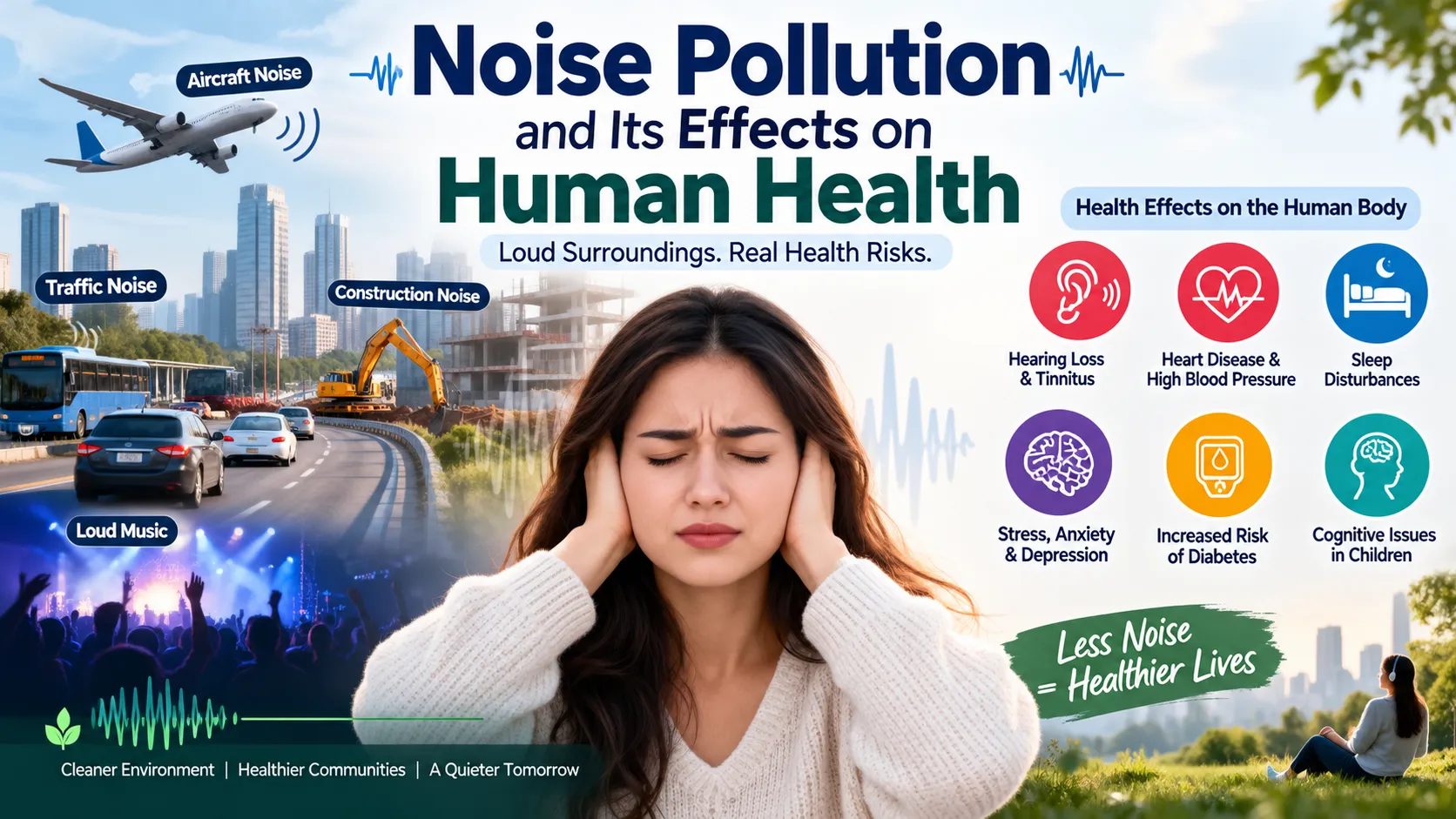
- Hearing: Permanent noise-induced hearing loss and tinnitus, both cumulative and irreversible once the hair cells are damaged.
- Cardiovascular system: Elevated blood pressure, increased heart attack and stroke risk, and higher rates of ischemic heart disease with long-term chronic exposure.
- Metabolic health: The 2025 EEA data specifically links nighttime transport noise to elevated type 2 diabetes risk, likely through the same chronic stress and sleep-disruption pathway.
- Sleep: Fragmented sleep architecture, reduced deep sleep, and daytime fatigue, often without the person realizing noise is the cause since full waking isn’t required for disruption.
- Cognitive function in children: Reading comprehension and memory measurably decline with chronic exposure to aircraft and traffic noise, an effect large enough that the EEA report attributes over 560,000 cases of impaired reading comprehension in children to transport noise in a single year.
- Mental health: Chronic noise annoyance is linked to elevated anxiety, irritability, and depressive symptoms, distinct from the physiological cardiovascular pathway; see our Mental Health section for more on managing chronic stress exposure.
The Decibel Scale and Where Your Risk Actually Starts
Decibels are logarithmic, not linear, which is the detail most explanations skip: 80 decibels isn’t twice as loud as 40; it’s roughly 10,000 times more intense. That’s why a jump of just a few decibels matters far more than it sounds like it should.
| Sound Level | Example | Health Note |
|---|---|---|
| 30–40 dB | A quiet library or bedroom at night | WHO recommends nighttime bedroom levels stay below roughly 30–40 dB for undisturbed sleep |
| 60–70 dB | Normal conversation, city traffic from inside a car | Prolonged exposure above this range is where non-auditory stress effects start accumulating |
| 85 dB | A busy roadway at close range, heavy machinery | OSHA’s occupational action level — exposure above this over 8 hours requires a hearing conservation program |
| 100–110 dB | A concert, a rock venue, a chainsaw | Hearing damage can begin after minutes, not hours, at this level |
| 120+ dB | A jet engine at close range, a gunshot | Immediate risk of permanent hearing damage from a single exposure |
Noise Pollution and Its Effects on Wildlife
Noise pollution’s reach extends well past human neighborhoods, and the wildlife research includes some genuinely striking findings most articles never mention.
- Marine mammals and naval sonar: Sonar can reach roughly 235 decibels underwater and travel hundreds of miles, interfering with the echolocation whales and dolphins rely on to navigate, feed, and find mates. Every recorded mass stranding of multiple beaked whale species has coincided with naval sonar exercises, with researchers linking the strandings to decompression-sickness-like injuries caused by panicked, abnormal diving behavior.
- Feeding disruption in blue whales: A tagging study by the Cascadia Research Collective found that blue whales exposed to simulated sonar stopped foraging entirely; one whale went 62 minutes without feeding, representing roughly a tonne of lost krill intake for that day alone.
- Birdsong and reproduction: Urban traffic noise has been shown to shift the timing of birds’ dawn chorus and alter the pitch and structure of their calls, which interferes with mate attraction. Separate research has linked chronic noise exposure to bluebirds producing fewer chicks per clutch.
The underlying problem is the same across species: animals rely on sound to navigate, feed, find mates, and detect predators, and noise pollution interferes with all four functions at once. National Geographic’s overview of this research is a solid starting point for a deeper look.
Noise Pollution in the Urban Environment
Cities concentrate noise pollution’s health impact because they concentrate its two biggest drivers: road traffic and population density. Road traffic remains the dominant source of environmental noise in urban areas specifically, and the impact scales with how many people live within range of it.
- Nighttime noise is the hidden urban risk factor. The WHO Environmental Noise Guidelines for Europe specifically flag nighttime transport noise (measured as Lnight) as the more dangerous exposure window, since it drives the sleep-disruption and cardiovascular pathway even in residents who report being “used to” the noise and no longer consciously notice it.
- Exposure isn’t evenly distributed within a city. Housing near highways, airports, and rail lines is disproportionately older and more affordable, which means lower-income urban residents often carry a meaningfully higher chronic noise burden than the city average.
- Urban design interventions have measurable effects. Quieter road surfaces, vegetated noise barriers, and traffic-calming measures have all been shown to reduce measured decibel exposure at the building facade level, which is where the health-relevant exposure actually happens.
Who Faces the Highest Risk
- Children: Still-developing auditory and cognitive systems, plus the specific reading-comprehension and behavioral effects tied to school and home proximity to transport noise.
- Shift workers and light sleepers: Daytime sleep in a noisier ambient environment compounds both the auditory-independent stress pathway and general sleep debt.
- People with existing cardiovascular disease: Chronic noise exposure acts as an additional physiological stressor on top of existing risk.
- Occupational noise-exposed workers: Construction, manufacturing, aviation ground crew, and music industry workers face direct auditory risk requiring formal hearing conservation measures.
- Residents near highways, airports, and rail corridors: The population bearing the largest share of the cardiovascular and metabolic disease burden described above.
Common Mistakes People Make About Noise Pollution
- Treating noise as purely an annoyance, not a health risk. The non-auditory cardiovascular and metabolic pathway operates regardless of whether the noise bothers you consciously.
- Assuming quiet sleep means safe sleep. Noise below your waking threshold can still fragment sleep architecture and trigger the stress response. “I slept through it” doesn’t mean it had no effect.
- Using the wrong hearing protection for the exposure. Foam earplugs and earmuffs have different noise reduction ratings (NRR); matching the rating to the actual decibel level of the task matters more than just “wearing something.”
- Ignoring cumulative exposure. A single loud concert feels like a one-off event, but hearing damage accumulates across a lifetime of exposures, not just the worst single incident.
- Assuming white noise machines are automatically safe. Running one at high volume to mask outdoor noise can itself exceed recommended nighttime decibel levels, especially for infants placed close to the device.
A Practical Framework for Reducing Your Noise Exposure
- Measure before you guess: a calibrated decibel meter app gives you a real baseline for your bedroom, workspace, or commute rather than relying on how loud something “feels.”
- Apply the 85-decibel, 8-hour rule as a personal guideline, not just an occupational one: exposure time should drop as decibel level rises, roughly halving the safe duration for every 3 dB increase.
- Address nighttime noise specifically, even if you don’t wake up: sound-dampening curtains, sealing gaps around windows, and white noise kept at a moderate, steady volume all measurably reduce the sleep-disruption pathway.
- Match hearing protection to the task: foam plugs for moderate, steady noise; earmuffs or custom-molded protection for high-decibel or impulse noise like firearms or power tools.
- Get a baseline hearing test if you work in a noise-exposed role, so any change over time is caught early rather than only after tinnitus or noticeable loss develops. Our Doctors section can help you think through when that’s worth scheduling.
- If chronic community noise is the issue, document decibel levels and times, and raise it with local zoning or environmental health authorities. Urban noise interventions are typically driven by documented resident complaints, not assumed need.
Frequently Asked Questions
What are the effects of noise pollution on human health?
Noise pollution causes both direct auditory damage permanent hearing loss and tinnitus and non-auditory effects driven by a chronic stress response, including elevated cardiovascular disease risk, disrupted sleep, impaired cognitive development in children, and higher rates of anxiety and metabolic disease.
How does noise pollution affect wildlife?
Noise interferes with the sound-dependent behaviors animals rely on to survive: navigation, feeding, mate-finding, and predator detection. Documented effects include naval sonar causing whale strandings, sonar-linked feeding disruption in blue whales, and traffic noise altering birdsong timing and reducing chick production.
What decibel level is considered dangerous?
Sustained exposure above 85 decibels over an 8-hour period is the standard occupational threshold requiring hearing protection. Levels above 100 to 110 decibels can cause damage within minutes, and anything above 120 decibels carries immediate risk from even brief exposure.
Can noise pollution affect health even if it doesn’t wake me up?
Yes. Sub-waking noise exposure during sleep still triggers a measurable stress response, elevated cortisol and heart rate, and this repeated nightly activation is the mechanism researchers link to increased cardiovascular and metabolic disease risk from nighttime traffic noise specifically.
What’s the difference between noise pollution’s auditory and non-auditory effects?
Auditory effects are direct physical damage to the inner ear from loud sound, causing permanent hearing loss and tinnitus. Non-auditory effects are the body’s stress response to unwanted or unpredictable noise, driving cardiovascular disease, sleep disruption, and cognitive impacts, and this pathway doesn’t require the sound to be loud enough to damage hearing at all.
Final Thoughts
Noise pollution and its effects on human health extend well beyond hearing loss, and the research increasingly shows that the noise you’ve stopped consciously noticing may be doing the most damage. The cardiovascular and metabolic risks operate through a stress pathway that doesn’t require waking or annoyance, which is exactly why measuring actual exposure, protecting sleep specifically, and matching hearing protection to real decibel levels matter more than judging risk by how loud something feels.