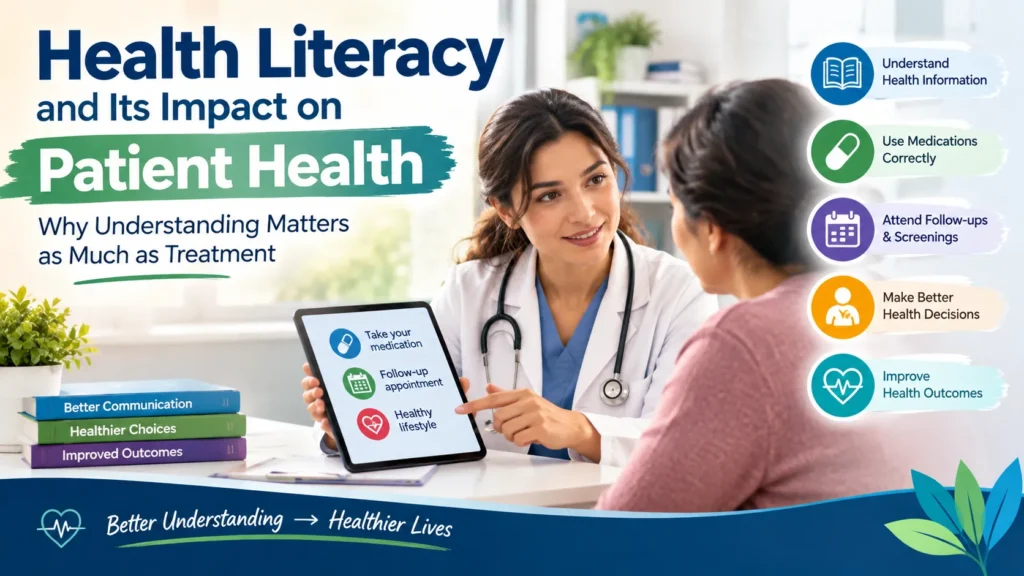


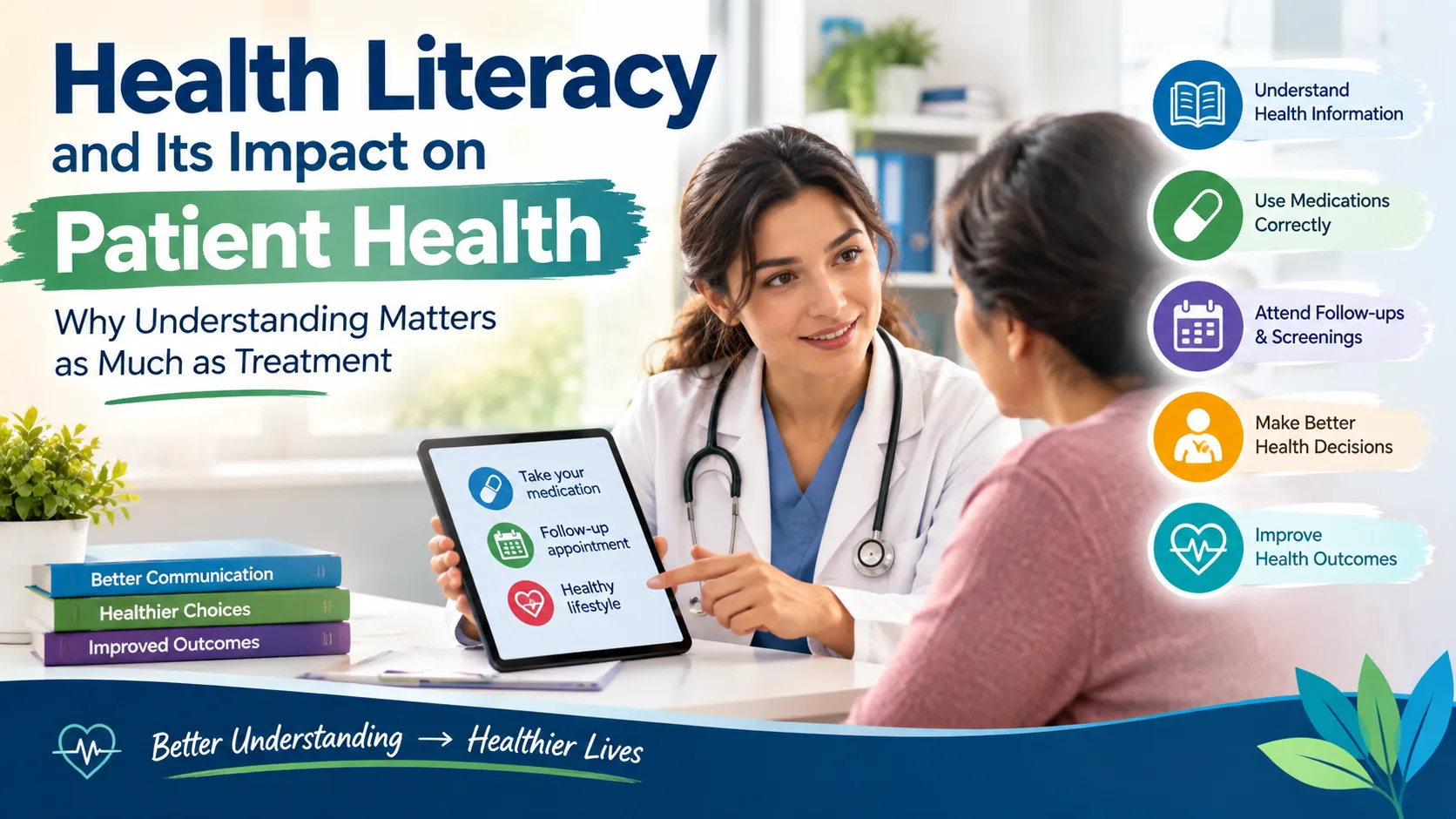
A patient leaves the clinic with a new prescription, a discharge summary, and a follow-up date. Whether that visit actually helps depends on one more thing: can the patient understand and use what they were told? Health literacy and its impact on patient health is the reason two people with the same diagnosis and the same doctor can end up with very different results. This guide explains what the concept really measures, what the evidence says about its effect on outcomes, prevention, and patient care, how limited understanding plays out in communities, and what patients and clinicians can do about it starting at the next appointment. For related reading, our Public Health section covers the wider system these problems sit inside.
What Health Literacy Really Means (and What It Isn’t)
Under Healthy People 2030, health literacy has two parts. Personal health literacy is a person’s ability to find, understand, and use health information and services to make decisions. Organizational health literacy is how well a clinic, hospital, or agency makes that possible for the people it serves. The second half matters: the newer definition puts responsibility on the system, not only on the patient.
Two points get lost in most explanations:
- It is not the same as education or intelligence. A lawyer with a new cancer diagnosis, a stack of unfamiliar terms, and a frightening prognosis can have low functional health literacy on that day. Stress, pain, and medical jargon lower everyone’s ability to absorb information.
- It includes numbers and navigation. Reading a pill label, calculating a dose, comparing insurance plans, and finding the right department all count. Many people who read well still struggle with the numeracy and system-navigation parts.
The most recent national measurement, the 2003 National Assessment of Adult Literacy, is old, but it is still the benchmark most agencies cite:
| Level | Share of US Adults (2003) | Typical Task They Can Complete |
|---|---|---|
| Proficient | 12% | Use a table to calculate an employee’s yearly share of health insurance costs |
| Intermediate | 53% | Read a prescription label and work out when the next dose is due |
| Basic | 21% | Read a pamphlet and give two reasons a person without symptoms should be tested |
| Below Basic | 14% | Read short instructions and identify what is allowed to drink before a medical test |
Roughly nine in ten adults, in other words, struggle with at least some everyday health information. The gap is not evenly spread. A 2024 fact sheet from the Center for Health Care Strategies reports that 60% of people with Medicaid coverage sit at basic or below-basic levels, compared with 24% of people who have employer-sponsored coverage.
Health Literacy and Its Impact on Health Outcomes: What the Evidence Shows
Researchers have linked limited skills in this area to a long list of poorer results. The pattern is consistent across many studies:
- More hospital and emergency use: Patients with low health literacy are hospitalized more often and visit emergency rooms more, and some analyses put the added hospitalization risk near 50%.
- More medication errors: Misreading dose instructions is the safety problem most often tied to this gap.
- Weaker chronic disease control: Worse blood sugar control in diabetes and lower knowledge of self-management steps in asthma, heart disease, and hypertension.
- Lower use of preventive care: Fewer vaccinations and cancer screenings, and later care-seeking once symptoms appear.
- Higher mortality among older adults: Research links limited health literacy to higher death rates among older adults, though the size of the gap varies from study to study.
The financial side is large too. The Agency for Healthcare Research and Quality estimates that health literacy problems cost the US health system between $106 billion and $238 billion each year.
A critical note for anyone reviewing this research: most of these findings are associations, not proof of cause. Low health literacy overlaps with low income, language barriers, and limited access to care, and those factors also worsen outcomes. Still, the case for a direct effect is strong. Some studies that account for these factors still find a link, and interventions that simplify communication, such as teach-back, are reported to improve understanding and adherence. Treat it as one important, fixable factor, not the only one.
Health Literacy and Disease Prevention
Prevention asks people to act while they feel fine, which makes it depend heavily on understanding.
- Screening: A person who cannot see why a symptom-free mammogram or colon test matters will skip it. Explaining the reason in plain terms often does more than sending another reminder.
- Risk numbers: “Your risk doubles” sounds alarming; “from 1 in 1,000 to 2 in 1,000” is the same fact in a form people can weigh. Relative risk without absolute risk confuses almost everyone.
- Vaccines: Unclear dose schedules, confusing eligibility rules, and online misinformation land hardest on people who cannot easily check a claim against a trusted source.
- Lifestyle advice: “Eat a heart-healthy diet” is a slogan. “Swap one sugary drink a day for water” is an action.
Health Literacy and Patient Care: Where Things Go Wrong in the Clinic
Most breakdowns are small and ordinary, which is why they go unnoticed.
- The instruction that means two things. “Take twice daily” might become two pills at breakfast. “Every 12 hours” is harder to misread.
- Discharge paperwork written for clinicians. Terms like “NPO,” “monitor for sequelae,” or “follow up PRN” leave patients guessing after they get home.
- The polite nod. Shame keeps many patients from admitting confusion. They say “yes” to “Do you understand?” and leave with questions.
- Patient portals and forms. Online results and long intake forms assume digital skills and reading comfort that many patients do not have.
Clinicians are also poor at spotting the problem by sight. In one study of resident physicians, only about 10% of patients were flagged as having poor health literacy, while the true figure was above 30%. Watch for red flags instead: incomplete forms, frequent missed appointments, “I forgot my glasses,” or a patient who studies a label rather than reading it.
Low Health Literacy in the Community
This is also a community-level issue, not just a bedside one. When many residents struggle to understand health information, the effects show up in local numbers: more preventable emergency visits, lower vaccination and screening rates, and faster spread of misinformation through families and social networks.
- Who is most affected: Older adults, people with limited English proficiency, low-income households, and people with chronic conditions who face the heaviest information demands.
- What works locally: Community health workers and trusted messengers, materials written at a commonly recommended sixth-to-eighth-grade reading level, translated and picture-based instructions, and pharmacy- or church-based sessions that let people ask questions without embarrassment.
- What organizations owe the community: Clear signs, plain-language forms, and staff trained to check understanding. Our Hospitals & Clinics and Healthcare Management sections cover how facilities can build these habits into daily operations.
Common Mistakes Clinicians and Patients Make
- Asking “Do you understand?” It invites a reflexive yes. Ask the patient to explain the plan back instead.
- Assuming education equals understanding. Highly educated patients still miss medical terms outside their field.
- Handing over a pamphlet and moving on. Written material helps only after someone walks through the two or three points that matter most.
- Covering too much in one visit. People retain a small share of what they hear when overloaded; five instructions often become none.
- Patients staying silent to avoid embarrassment. Asking a simple question is a safety step, not a weakness.
A Practical Framework for Improving Health Literacy
If You Work in Healthcare
The AHRQ Health Literacy Universal Precautions Toolkit rests on one idea: assume every patient may have trouble understanding, and design for that. In practice:
- Use plain language and short sentences. Replace “hypertension” with “high blood pressure” and define any term you cannot replace.
- Limit each visit to the two or three points the patient must remember, and put them in writing.
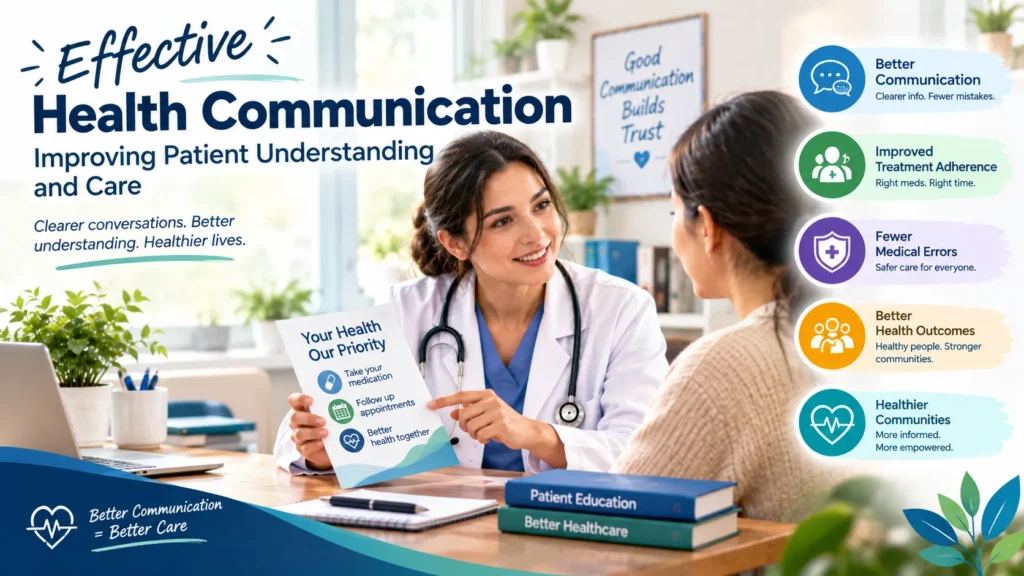
- Use teach-back on every patient. Say, “I want to be sure I explained this well. What will you do when you get home?”
- Remember that teach-back checks your explanation, not the patient’s intelligence. If they miss something, explain it another way and check again; the AHRQ teach-back guide walks through this.
- Use show-me for physical tasks such as inhalers, injections, and wound care, and give pill cards for multi-drug regimens.
- Test forms, portal pages, and handouts with real patients before rolling them out.
If You Are a Patient or Caregiver
- Ask the three questions from the Ask Me 3 approach, developed by health literacy experts at the Institute for Healthcare Improvement, at every visit: What is my main problem? What do I need to do? Why is it important for me to do this?
- Bring a written list of questions and, if possible, a family member or friend to help remember the answers.
- Ask the clinician to repeat instructions in different words, or to write them down.
- Use the pharmacist as a second explainer for every new medicine, and ask them to show you the dose on the label.
- Say so if something is unclear. If you are unsure how to raise it, our Doctors section offers ideas for preparing for appointments.
Frequently Asked Questions
Why is health literacy important?
It determines whether people can follow treatment, manage long-term conditions, use preventive care, and navigate the health system safely. Limited health literacy is linked to more hospitalizations, more medication errors, and higher costs.
How does health literacy affect health?
People who understand health information tend to take medicines correctly, seek care earlier, and get recommended screenings and vaccines. People who do not are more likely to make errors, delay care, and end up in emergency settings.
How does literacy affect health more broadly?
General literacy and numeracy shape how well a person reads labels, follows instructions, and weighs risks. The health-specific version adds the ability to use medical terms, understand health systems, and apply information to personal decisions.
What is the impact of health literacy on disease prevention?
Clear understanding increases screening, vaccination, and early symptom reporting, while confusion about risk and eligibility leads people to skip preventive care.
Is low health literacy the same as low education?
No. Stress, illness, language barriers, and unfamiliar terms can lower health literacy for well-educated people, and health literacy can be improved through better communication.
Final Thoughts
Health literacy and its impact on patient health comes down to a simple test: did the person leave knowing what to do, and why? The evidence links a failed test to more hospital stays, more errors, and weaker prevention, but it also shows the problem is fixable. Plain language, teach-back, and a shame-free space cost little, and they work for every patient, not only those who struggle. Whether you are the clinician or the patient, the next appointment is a good time to start.