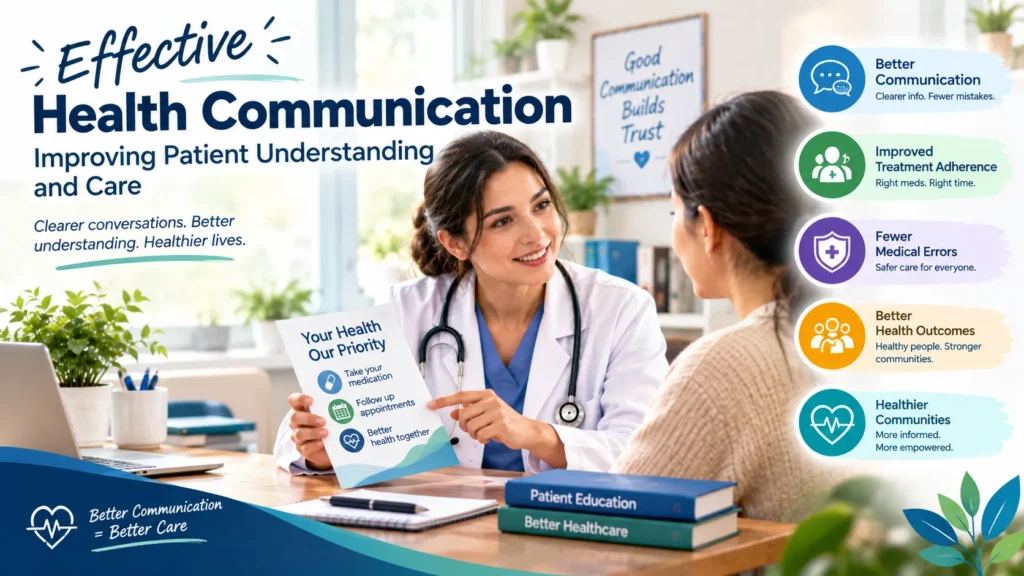


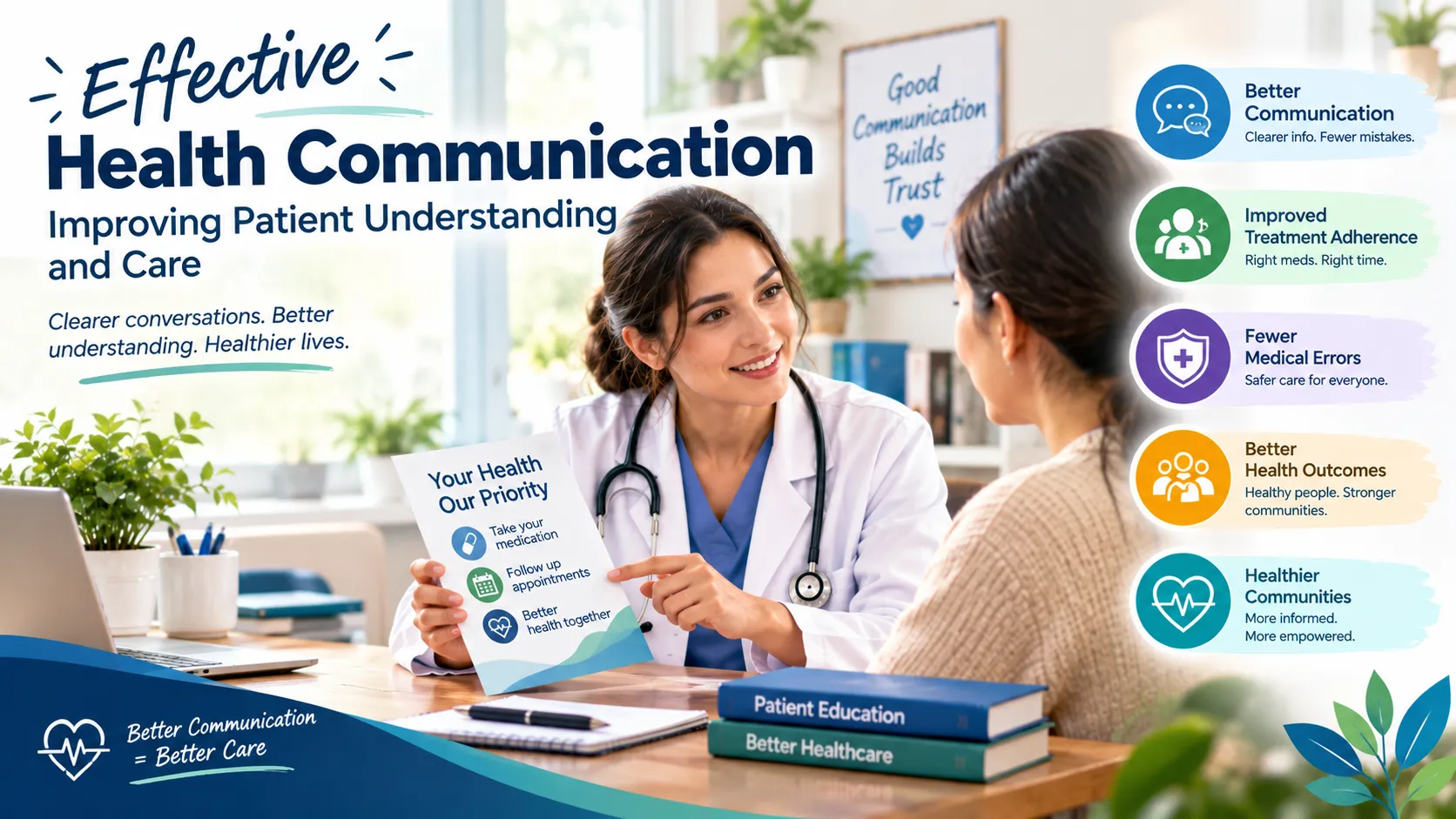
A prescription explained clearly gets taken correctly. The same prescription explained in a rush, full of jargon, gets misread, skipped, or doubled up. Effective health communication is the difference between the two, and it shapes outcomes everywhere health information changes hands: in a clinic, in a public health campaign, in a care home, and on a factory floor safety briefing. This guide covers what effective health communication actually involves, the attributes researchers say it requires, how it plays out with children, in social care, in workplace safety, in campaigns, and globally, and it ends with a practical framework you can use starting with your next conversation. For the patient side of this equation, our Health Literacy guide covers what happens when understanding breaks down.
What Effective Health Communication Involves
At its core, health communication is a simple loop: a sender shapes a message, sends it through a channel, a receiver interprets it, and feedback tells the sender whether it landed. Most breakdowns happen at the interpretation and feedback steps, not the sending step, which is why talking more or writing more does not by itself fix poor communication.
- Verbal communication: Spoken explanations, questions, and the back-and-forth of a consultation. Tone and pacing carry as much meaning as the words themselves.
- Non-verbal communication: Eye contact, posture, and facial expression. A rushed posture can undercut a reassuring sentence.
- Written communication: Discharge instructions, prescription labels, consent forms, and patient portal messages, which carry the weight of decisions once the conversation has ended.
Effective health communication, in short, involves matching the message to the audience, choosing a channel the audience actually uses, and building in a way to check the message was received as intended.
The Attributes Effective Health Communication Requires
This is where most searches on this topic land, often from a course or quiz. The list below is adapted from the framework used by the CDC’s health communication guidance and the National Cancer Institute’s planning guide for health communication programs.
| Attribute | What It Means in Practice |
|---|---|
| Accuracy | The content is correct and free of errors, and reflects current evidence. |
| Availability | The message reaches people where they already look for information, not just where it is convenient to post it. |
| Balance | Benefits and risks, or what is known and unknown, are both presented, not just the reassuring half. |
| Consistency | The message stays the same across channels and over time, or clearly explains why it has changed. |
| Cultural competence | Language, examples, and imagery reflect the audience’s background, beliefs, and disability needs. |
| Evidence base | Recommendations rest on a real review of research, not a single study or opinion. |
| Reach | The format and distribution get the message to as much of the intended audience as possible. |
| Reliability | The source is credible, and the content is kept current as evidence changes. |
| Repetition | Key points are repeated over time and across contacts, since one exposure rarely changes behavior. |
| Timeliness | The message arrives when the audience needs it or is ready to act on it. |
| Understandability | The reading level, structure, and terms match what the audience can actually process. |
Notice what is missing from this list: persuasion tricks and clever slogans. Every attribute here is about respecting the audience’s ability to evaluate information and act on it, which is also what separates health communication from advertising.
Effective Communication Skills for Healthcare Professionals
- Active listening: letting a patient finish a thought before responding, and reflecting back what was heard before moving to advice.
- Teach-back, not “do you understand”: Asking a patient to explain the plan in their own words catches gaps that a yes-or-no question hides. Our Health Literacy guide covers this technique step by step.
- Plain language by default: Saying “high blood pressure” instead of “hypertension” costs nothing and excludes no one who already knows the medical term our Doctors section has more on preparing for a clear, two-way conversation at appointments.
Handoffs between professionals need their own structure, because urgency and hierarchy both work against clear communication. SBAR (Situation, Background, Assessment, Recommendation) was built at Kaiser Permanente, adapted from a communication protocol used on US Navy submarines, specifically to bridge the gap between a nurse’s narrative style and a physician’s need for a fast, focused update. A nurse using SBAR states the situation in one sentence, gives only the background that matters, shares an assessment, and ends with a specific recommendation, which removes the guesswork a rushed, unstructured call invites. Our Hospitals & Clinics section covers more on how facilities build these habits into daily practice.
Effective Healthcare Communication With Children and Young People
Communicating with a child is not a smaller version of communicating with an adult; it needs its own approach.
- Match language to developmental stage, not just age. A calm seven-year-old and an anxious seven-year-old may need very different amounts of detail in the same moment.
- Explain the sensation, not just the procedure. “This will feel cold, then a small pinch” prepares a child better than a clinical description of the procedure itself.
- Give real choices where they exist. Which arm for the injection, or which sticker afterward, restores a sense of control without compromising care.
- Talk to the child, not just past them. Addressing a young patient directly, even briefly, before turning to a parent for detail, builds trust and models respect for the caregiver watching.
- Check understanding with a young person the same way as an adult. Teenagers especially can nod along to avoid seeming uninformed; a specific follow-up question works better than a general one.
Effective Communication in Health and Social Care: Barriers and Solutions
In social care settings, communication has to work around barriers that a busy clinic can sometimes ignore.
- Sensory barriers: Hearing or vision loss in older residents, addressed by facing the person directly, written backup, and hearing loop systems rather than raised volume alone.
- Cognitive barriers: Dementia and memory impairment, addressed with short, single-step instructions and consistent daily routines rather than long explanations.
- Language and cultural barriers: Addressed with professional interpreters rather than family members, whose presence can change what a patient is willing to disclose.
- Environmental barriers: Background noise and interruptions in shared spaces, addressed by moving sensitive conversations somewhere private whenever possible.
- Emotional barriers: Fear, grief, or shame, addressed by naming the emotion in the room before pushing ahead with information the person cannot yet absorb; see our Mental Health section for more on supporting someone through a hard conversation.
Health Communication and Health and Safety
Health and safety communication is often treated as paperwork, but the same principles apply as anywhere else in health communication, with less room for error.
- Signage should instruct, not just warn. “Wet floor” tells someone a hazard exists; “walk here instead” with an arrow tells them what to do about it.
- Safety briefings work better short and frequent than long and rare. A two-minute daily huddle on a specific risk beats a lengthy monthly meeting most people mentally check out of.
- Incident reporting needs a blame-free channel. Workers under-report near-misses when they fear consequences, which removes the early-warning data safety programs depend on.
- Multilingual workplaces need translated safety materials, not just translated posters. A safety data sheet only helps if the worker handling the chemical can actually read it.
What Makes an Effective Health Communication Campaign Work
Public health campaigns fail most often not because the message is wrong, but because the process skipped a step, a pattern that shows up often in the campaigns our Public Health section covers.
- Define one target audience and one target behavior; a campaign trying to reach everyone about everything reaches no one about anything.
- Pretest the message with real members of the target audience before wide release, since messages that make sense internally often confuse the public.
- Use multiple channels the audience actually uses, since reach and repetition both depend on showing up where people already are.
- Build in a feedback and evaluation step, not just a distribution plan, so the campaign can be corrected mid-run rather than only judged afterward.
During an actual emergency, the calculus shifts toward speed. The CDC’s Crisis and Emergency Risk Communication (CERC) framework, built after events like anthrax exposures and major hurricanes, centers on six principles: be first, be right, be credible, express empathy, promote action, and show respect. Being first with an honest “here is what we know and don’t know yet” consistently outperforms waiting for a complete, polished answer, because the first source people hear from usually becomes the source they trust for updates.
Health Communication for Sustainable Development
Globally, health communication is treated as core infrastructure, not an add-on, because it underpins progress on WHO’s health promotion and Sustainable Development Goals agenda, particularly SDG 3 on health and wellbeing. In practice, this means investing in community health workers who deliver messages in person in the local language, adapting materials for low-literacy and multilingual populations rather than only translating a Western template, and measuring whether messages reach the poorest and most remote communities, not just the easiest ones. A vaccination campaign that only reaches people with reliable internet access, for instance, systematically misses the populations facing the highest disease burden.
Common Mistakes in Health Communication
- Asking “does that make sense?” It invites a reflexive yes rather than real confirmation of understanding.
- Treating one message as one-and-done. Repetition is one of the attributes above for a reason; a single mention rarely changes behavior.
- Writing for peers instead of the audience. Clinical language that reads fine to another clinician can be opaque to the patient it was written for.
- Skipping the feedback loop. A campaign or a consultation without a way to measure understanding cannot be corrected until it has already failed.
- Ignoring the messenger’s credibility. An accurate message from a distrusted source often lands worse than a slightly imperfect one from a trusted messenger.
A Practical Framework for Effective Health Communication
- Identify the audience and the one action you want them to take before drafting a single word.
- Draft the message in plain language, then cut every word a general reader would need to look up.
- Check the message against the attributes above: is it accurate, balanced, culturally appropriate, and timed for when the audience needs it?
- Choose the channel your specific audience already uses, rather than the channel that is easiest for you to produce.
- Build in a way to check understanding, whether that is teach-back in a consultation or a short survey after a campaign.
- Repeat the core message across at least two more contacts or touchpoints, since one exposure is rarely enough.
- Review and adjust based on what the feedback step actually shows, not on how clear the message felt to write.
Frequently Asked Questions
What does effective health communication involve?
It involves shaping a message for a specific audience, choosing verbal, non-verbal, or written channels that reach them, and building in feedback to confirm the message was understood as intended.
What attributes does effective health communication require?
Commonly cited attributes include accuracy, availability, balance, consistency, cultural competence, evidence base, reach, reliability, repetition, timeliness, and understandability.
What is effective communication in health and social care?
It means adapting communication around sensory, cognitive, language, environmental, and emotional barriers that are common in care settings, using tools like professional interpreters, short single-step instructions, and private spaces for sensitive conversations.
How can healthcare professionals communicate more effectively?
Active listening, plain language, and teach-back address most day-to-day gaps, while structured tools like SBAR improve handoffs and communication between professionals during time-pressured situations.
Why does health communication matter for sustainable development?
Global health goals depend on messages reaching the populations with the highest disease burden, which often means low-literacy, multilingual, or low-connectivity communities that generic, one-channel campaigns miss entirely.
Final Thoughts
Effective health communication is not a talent some clinicians have, and others lack; it is a set of specific, learnable habits: plain language, teach-back instead of a yes-or-no question, structured handoffs like SBAR, and a real feedback loop instead of a one-way message. Whether the setting is a bedside conversation, a care home, a safety briefing, or a national campaign, the same underlying test applies: did the message actually change what the person understood and what they do next?