

| My Story I spent three years hunched over a laptop before I realized my chronic neck pain was not a medical mystery , it was simply bad posture. Once I committed to fixing it, the difference was remarkable. Here is everything I learned, backed by research and lived experience. |
If you have been wondering how to improve posture, you are not alone. Poor posture has become one of the defining physical complaints of the digital age. The good news: with the right approach, it is genuinely fixable and you do not need a gym membership or expensive gadgets to start.
Why Posture Matters More Than You Think
Posture is not just about appearances. It describes the way you hold your body during movement and rest and when it is off, the consequences ripple through nearly every system in your body. Your spine has three natural curves: at the neck (cervical), mid back (thoracic), and lower back (lumbar). Good posture maintains these curves in balance. Poor posture distorts them.
| Statistic | Figure |
| US adults affected by poor posture (2024) | 54 million+ |
| Adults with forward head posture | 66% |
| Phone users reporting musculoskeletal pain | 80% |
| Reduction in joint pressure with good alignment | Up to 40% |
| Improvement in breathing efficiency with good posture | ~30% |
| Forward head posture improvement after 8-week exercise programme | 42% |
| WarningPoor posture is linked not only to back and neck pain but also to decreased flexibility, poor balance, impaired digestion, and difficulty breathing. Bad posture habits formed early in life are especially likely to become ingrained structural problems over time. |
What Good Posture Actually Looks Like
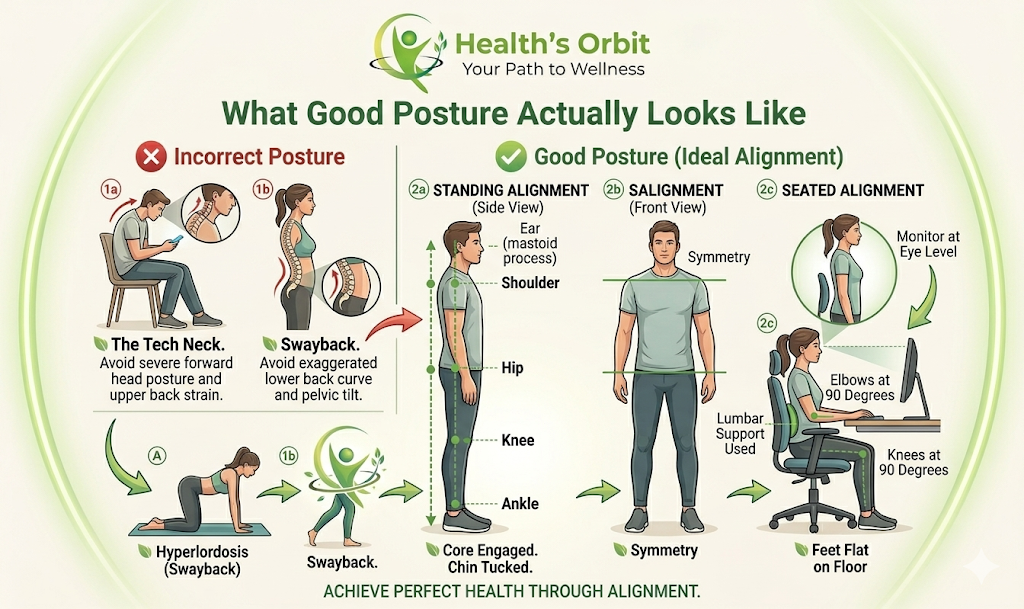
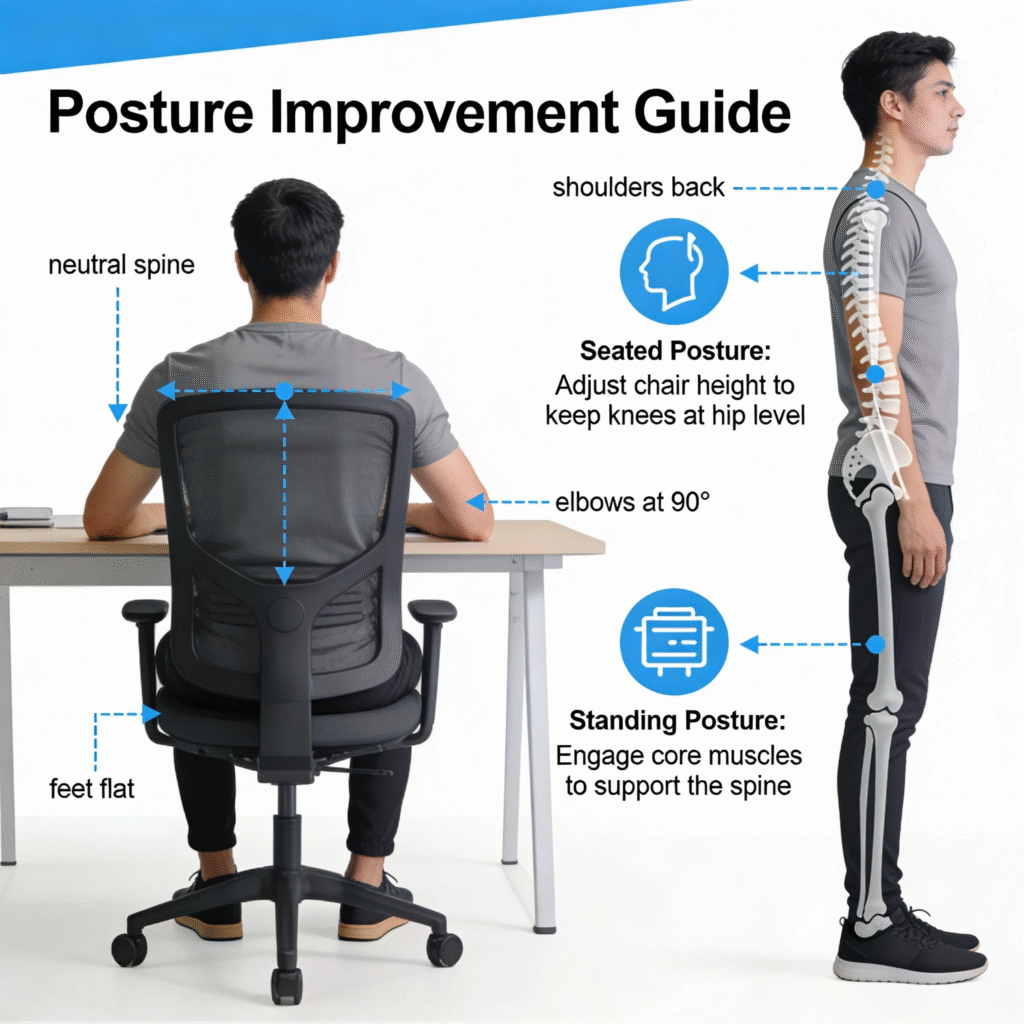
Before you can fix something, you need to know what it looks like. Good posture when standing means your ears sit directly above your shoulders, your shoulders above your hips, your hips above your knees, and your knees above your ankles. Imagine a straight vertical line from ceiling to floor , it should pass through all of these points simultaneously.
When sitting, your feet should be flat on the floor, knees at roughly 90 degrees, lower back gently supported, and your screen at eye level so your neck stays neutral. The most common deviation is what physiotherapists call ‘upper cross syndrome’ , a forward head, rounded upper spine, and hunched shoulders , which is nearly the default position for laptop and smartphone users.
| �� Quick Self-Check — The Wall TestStand with your back flat against a wall, heels about 2.5 cm away. Your head, shoulder blades, and buttocks should all touch the wall simultaneously. If your head cannot reach without strain, forward head posture is likely already a factor for you. |
How to Improve Posture: The Core Strategies That Work1.
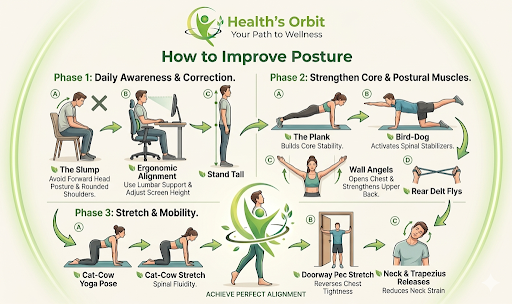
Strengthen the Right Muscles
The single biggest thing I did to improve my posture was strengthening my posterior chain , the muscles running down the back of my body. Most of us with desk jobs have chronically weak rhomboids, deep neck flexors, and glutes, and overactive, tight chest muscles and hip flexors. This muscular imbalance is what pulls the body into a slouch.
Clinical research confirms that targeted exercise programmes can improve forward head posture by 42% and reduce rounded shoulders by 38% when practised consistently over eight weeks. Here are the key exercises worth knowing.
| Exercise | Targets | How to Do It | Reps / Sets |
| Wall angels | Rhomboids, lower trapezius, shoulder mobility | Stand against the wall, arms in goal-post. Slide arms up and down maintaining wall contact. | 15–20 reps, 2x daily |
| Chin tucks | Deep neck flexors (forward head fix) | Draw chin back to create a slight double-chin. Hold 5 seconds, release. | 10 reps, 2–3x daily |
| Glute bridges | Glutes, core, lower back relief | Lie on your back, knees bent. Lift hips engaging glutes and core. Lower slowly. | 15 reps, 3 sets |
| Prone Y-T-W | Middle trapezius, rhomboids | Lie face down, lift arms into Y, T, W positions. Hold each 3 seconds. | 8–10 reps each |
| Plank | Core, glutes, hamstrings | Hold plank position with neutral spine. Build duration gradually. | 20–40 seconds, 3 sets |
| Doorway chest stretch | Pectoral muscles, anterior shoulder | Forearm on door frame, step forward gently. Hold 30 seconds each side. | 30 sec, 2–3x daily |
| �� Frequency NotePhysiotherapists recommend performing strengthening exercises 3–4 times per week. Stretching , especially chest and hip flexors , can be done daily. Allow a rest day between strength sessions. Mild muscle soreness is normal; pain is not. |
2. Redesign Your Workspace Ergonomics
No amount of exercise will fix posture problems if you return to the same bad environment for eight or more hours a day. Your monitor should sit at eye level , adjustable monitor arms can reduce neck flexion by an average of 15 degrees. Your chair should support the natural inward curve of your lower back, with feet flat on the floor and knees at roughly 90 degrees.
Physical therapists consistently advise checking your posture every 15 minutes and getting up to move at least every 30 minutes. Alternating between sitting and standing every half hour is especially effective , but increase standing time gradually to prevent fatigue and ensure you maintain good form in both positions.
3. Build Daily Movement Habits
One insight that shifted my entire approach was learning that the goal is not to find the perfect position and hold it , it is to move frequently and vary your position throughout the day. The best posture, as many physiotherapists put it, is the next one. Staying active overall matters enormously: even 30 minutes of low-impact exercise daily keeps muscles supple, supports healthy body weight, and improves the neuromuscular control that makes good posture feel natural.
Practices like yoga and tai chi are particularly effective because they develop body awareness alongside strength and flexibility. Setting a phone reminder every 30–60 minutes to do a quick posture check genuinely works in the early stages of building this awareness.
4. Address Sleeping Position and Footwear
Two factors that most articles overlook: sleep position and shoes. Sleeping on a mattress that supports your spine’s natural curves, and using the right pillow height for your sleep position, directly affects how your neck and spine feel during the day. When getting out of bed, roll to your side and push up using your arms, a habit that protects your lower back over years.
Footwear matters more than most people realise. High heels shift your centre of gravity forward, forcing your hips and lower back to compensate with an exaggerated curve. Flat, well-fitting shoes with arch support and even weight distribution are foundational to good posture, not optional extras.
Types of Poor Posture and What Causes Them
| Posture Type | What It Looks Like | Main Cause | Key Fix |
| Forward head (tech neck) | Head juts forward of shoulders | Phone and screen use | Chin tucks, screen at eye level |
| Rounded shoulders (kyphosis) | Shoulders curl inward, forward | Prolonged desk sitting | Chest stretches, wall angels |
| Swayback (lordosis) | Excessive lower back arch | Weak core, high heels | Core strengthening, flat shoes |
| Flat back | Natural curves reduced/absent | Tight hamstrings, inactivity | Hip flexor and hamstring stretches |
| Scoliosis-related | Lateral spinal curvature | Structural medical condition | Physiotherapist-guided programme |
Posture Improvement Approaches — Comparison Table
| Approach | Effectiveness | Time to Results | Best For |
|---|---|---|---|
| Targeted exercises (chin tuck, wall angels) | High | 4–8 weeks | Forward head, rounded shoulders |
| Ergonomic workspace setup | High | Immediate–1 week | Desk workers, all-day sitters |
| Yoga / tai chi | Moderate–high | 6–12 weeks | Body awareness, flexibility |
| Posture corrector braces | Low–moderate (short-term) | Reminder only | Not for long-term use |
| Physiotherapy | Very high | Varies | Structural issues, chronic pain |
| Standing desk alone | Low (without habits) | — | Must combine with movement habits |
| �� Key InsightPosture corrector braces can be useful as short-term reminders, but relying on them long-term can actually weaken the postural muscles you need to build. The goal is developing postural muscle memory , not outsourcing the work to a device. |
How Long Does It Take to Improve Posture?
This is the question I asked most at the start. The honest answer: it depends on how long the poor posture has been established and how consistently you apply the right habits. For most people with lifestyle-driven postural problems rather than structural medical conditions, noticeable improvement typically appears within 4 to 8 weeks of consistent exercise and ergonomic adjustment.
Full retraining of postural muscle memory , where good alignment feels automatic generally takes several months of consistent practice. Building posture habits into your existing daily routine is far more effective than intensive bursts followed by long gaps.
Frequently Asked Questions
1. How long does it take to noticeably improve posture?
Most people see noticeable improvement within 4–8 weeks of consistent targeted exercises and ergonomic adjustments. Clinical research confirms that specific posture programmes can reduce forward head posture by up to 42% in eight weeks. Full postural muscle memory , where good alignment feels natural , typically develops over several months of daily practice.
2. Can you fix years of bad posture?
Yes, in most cases. If poor posture stems from lifestyle habits , prolonged sitting, screen use, weak muscles , targeted exercises, ergonomic changes, and body awareness training can correct it over time. Structural conditions like scoliosis or kyphosis may require a physiotherapist’s guidance in addition to self-directed effort.
3. What is the single most effective exercise for posture?
There is no single best exercise, but chin tucks and wall angels are consistently rated most effective by physical therapists. Chin tucks directly target forward head posture by strengthening the deep neck flexors, while wall angels simultaneously strengthen the upper back and improve shoulder mobility , addressing the two most common postural problems together.
4. Is a standing desk good for posture?
A standing desk can help, but only when combined with good posture habits and frequent position changes. Standing with poor form , hips pushed forward, weight on one leg, neck craned , creates different but equally problematic postural strain. Alternate between sitting and standing every 30 minutes and maintain neutral alignment in both positions.
5. Does sleeping position affect posture?
Yes. Sleeping on a mattress that supports your spine’s natural curves and using a pillow at the right height directly influences daytime spinal alignment. Side sleepers benefit from a thicker pillow; back sleepers from a thinner one. Stomach sleeping places the greatest strain on the cervical spine and is generally not recommended.
| �� DisclaimerThis article is written based on personal experience and publicly available research. It is for informational purposes only and does not constitute medical advice. Consult a qualified physiotherapist or healthcare professional if you have persistent pain or a diagnosed spinal condition. |