


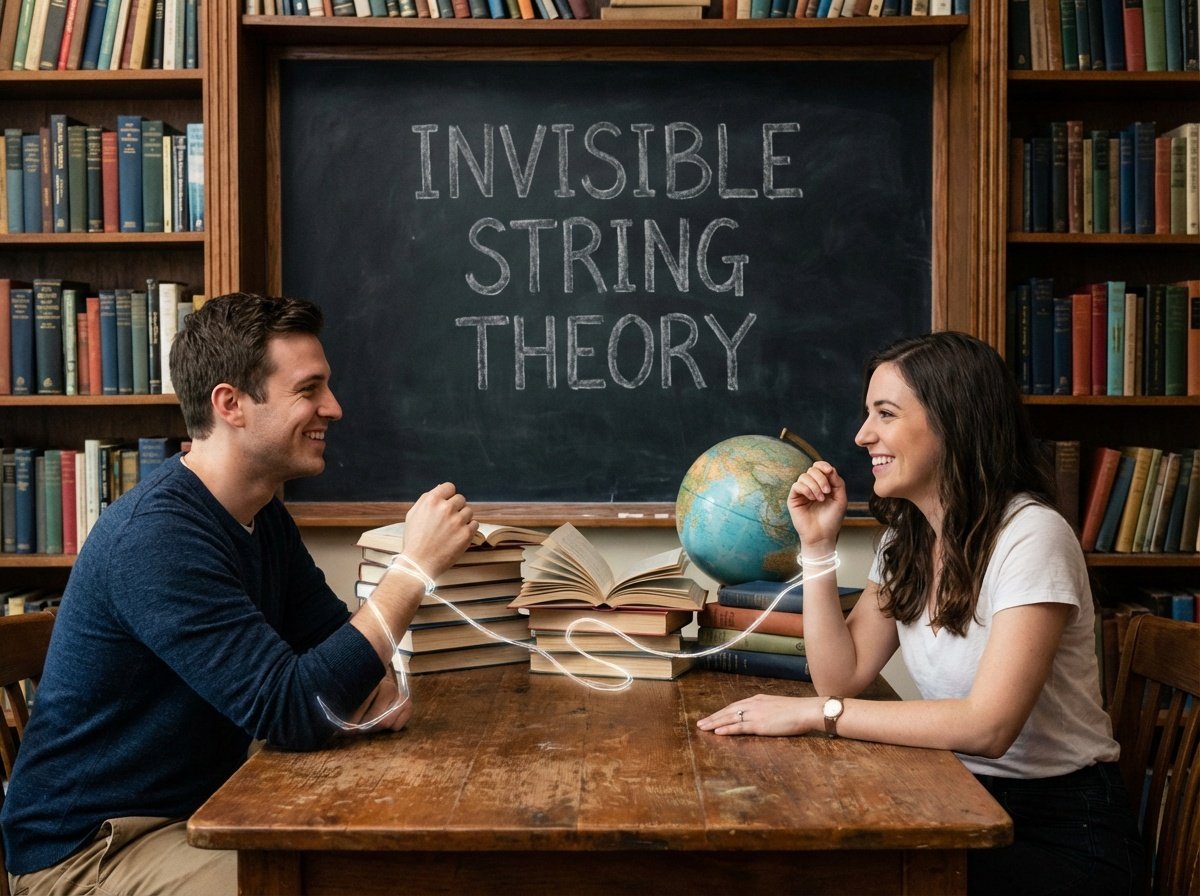
The first time I heard the phrase invisible string theory, I was sitting in a café watching my partner laugh at something across the room, someone I had almost never met. A wrong turn on a Tuesday changed everything. I think about that a lot. Was it a chance? Or was there always a thread pulling us together?
That question is exactly what the invisible string theory is about. And the more I have lived with it not as a fairytale but as a lens for understanding relationships the more I have come to see it as one of the most honest metaphors for how love, friendship, and even loss actually feel from the inside.
What Is the Invisible String Theory?
At its simplest, the invisible string theory is the belief that certain people in your life are not there by accident. It is the idea that two people are linked by an unseen thread that pulls them toward each other, no matter what and that certain relationships feel important not by chance, but because something bigger is connecting two people across time, distance, or life changes.
The invisible string theory follows the idea that you are connected to your soulmate via a metaphorical string. It is a belief rooted in spirituality and fate that can often provide a sense of belonging and comfort when pursuing romantic relationships, suggesting that one is always connected to someone and is not alone.
I want to be clear about something from the start: this theory is not scientific. It does not appear in peer reviewed journals, and no laboratory has measured the pull of an invisible thread between two hearts. But that does not mean it is without value. Some of the most powerful frameworks for understanding human experience live outside the hard sciences in story, myth, and metaphor. That is exactly where the invisible string theory lives, and it deserves to be understood on its own terms.
The Core Idea Visualized
Imagine a thin golden thread, stretched across time and geography. It may knot, fray, or loop back on itself. But it never truly breaks. Every person who has shaped your life, lover, friend, stranger at the right moment, was always at the other end of that thread, being pulled toward you before either of you knew the other’s name.
Where Did the Invisible String Theory Come From?
The Red Thread of Fate Ancient Eastern Roots
The invisible string theory probably originated from the Red Thread of Fate, also called the Red Thread of Marriage, a story from a Japanese Ancient Tale. It consists of an invisible red cord tied around the fingers of two people who are destined to meet.
An ancient Chinese proverb says that an invisible red thread connects those who are destined to meet regardless of time, place or circumstance. The thread may stretch or tangle but will never break. Red is the colour of the string because it represents happiness and luck, but it also happens to be a universally accepted colour of love.
I find it remarkable that cultures separated by thousands of miles and thousands of years arrived at the same image, an invisible cord binding two fated souls. That kind of convergence tells me something true is being described, even if the truth is emotional rather than empirical.
Ancient China / Japan
Red Thread of Fate mythology invisible cord ties destined lovers, regardless of circumstance.
- 1847
Charlotte Brontë’s Jane Eyre describes the feeling as a cord knotted under the ribs, connecting two hearts across distance.
- 2000
Patrice Karst published the children’s book The Invisible String, celebrating the idea that love ties people together across any separation.
- 2020
Taylor Swift released “Invisible String” as track 11 on her album Folklore, drawing on the imagery of a single thread that “ties you to your fate,” connecting two soulmates through the story of their separate lives.
- 2021 – Present
After the release of Folklore, TikTok content creators launched a viral trend using Taylor’s song, showing their partners and highlighting the idea that they were meant to find each other. The invisible string theory entered mainstream culture overnight.
The Literary Lineage
Literature has always known something that science has struggled to name: the sensation of feeling irreversibly connected to another person. Long before psychologists coined terms like attachment theory or destiny beliefs, storytellers were documenting the invisible string in plain, honest language.
Charlotte Brontë put it most directly in Jane Eyre (1847): I have a strange feeling with regard to you. As if I had a string somewhere under my left ribs, tightly knotted to a similar string in you.” What strikes me about that passage and why I come back to it often is that Brontë was not describing romantic idealism. She was describing a physical sensation. A tug. Something bodily, not imagined.
Ernest Hemingway explored a quieter version of the same idea in The Sun Also Rises (1926) characters circling each other across borders and years, pulled together by forces neither could articulate. The thread in Hemingway is tangled and painful. He understood, perhaps better than anyone, that the invisible string does not always lead somewhere good. It leads somewhere true.
What the literary tradition adds to this theory that TikTok trends rarely do is nuance. Books do not promise that your invisible string leads to happiness. They promise that it leads to meaning and those are two very different things. Jane Eyre and Rochester are pulled together by fate and nearly destroyed by circumstance. The string held. But holding is not the same as healing.
When Taylor Swift wrote on Folklore about a golden thread connecting two lives across years of near-misses, she was adding a new chapter to a very old story. The image of the invisible string persists across centuries precisely because it captures something true about how profound connections feel not chosen, but recognised.
The Psychology Behind the Invisible String Theory
Why Our Brains Are Wired to Believe in It
Belief in invisible string theory taps into deeper psychological wiring attachment patterns, pattern recognition, and the way we construct our life story. People with anxious attachment often cling to the idea of destiny because it gives shape to uncertainty. If a connection feels prewritten, it feels safer.
Skeptics argue that this theory is simply confirmation bias at work: our brain’s tendency to focus on information that supports what we already believe while ignoring contradicting evidence. If you believe you are “tied” to someone, you will notice every coincidence: running into them unexpectedly, sharing the same niche interests. But what about all the other random people you cross paths with daily and never think twice about?
I think both things can be true at once. Confirmation bias is real. And yet the experience of feeling cosmically connected to certain people is also real. The invisible string theory does not have to be literally true to be psychologically meaningful. What matters is how we use it.
📌 Note for Readers
The invisible string theory is a metaphorical concept, not a clinical or scientific framework. It is best used as a tool for reflection and emotional meaning-making not as a guide for relationship decisions. A licensed therapist can help you explore these ideas in a healthy, grounded way.
What Research Actually Says About Destiny Beliefs
Psychologists who study romantic relationships have long identified two opposing mindsets that shape how people approach love. Dr. C. Raymond Knee of the University of Houston, who pioneered this area of study, called them destiny beliefs, the conviction that relationships are either meant to be or they are not and growth beliefs, the understanding that good relationships are built, not found.
People who hold strong destiny beliefs tend to experience higher relationship satisfaction in the early stages of a new connection. The sense of fated alignment feels exciting and validating. But Knee’s research, along with followup studies, consistently found that destiny believers are quicker to abandon relationships at the first sign of conflict. If things feel hard, the logic of destiny whispers: maybe this wasn’t meant to be after all.
A two-year longitudinal study tracking couples found that early satisfaction scores among destiny believers were notably higher but did not predict whether couples were still together or happy at the study’s end. Growth believers, who entered relationships with less euphoria but more flexibility, showed more stable trajectories over time.
There is also a pattern-seeking dimension. Research in cognitive psychology confirms that once we believe we are connected to someone, our brains actively search for confirming evidence, shared interests, uncanny timing, mutual friends we forgot we had. This is not self-deception. It is the brain doing what it does best: constructing a coherent story from fragments. The invisible string theory gives that story a name.
My honest interpretation after sitting with this research
Destiny beliefs are most useful as ignition, not navigation. They give you the courage to pursue a connection that might have otherwise felt too uncertain. But they are a poor compass for deciding whether to stay, leave, or forgive. That work requires judgment not fate.
The Benefits and Risks of Believing in Invisible String Theory
| Dimension | Potential Benefits | Potential Risks |
| Romantic Relationships | Reduces pressure to “find the one,” encourages patience and trust | Can justify staying in harmful or one-sided relationships |
| Mental Health | Provides comfort, hope, and reduces loneliness after breakups | May delay closure, prolong grief, or reinforce anxious attachment |
| Self-Growth | Encourages reflection on meaningful past connections | Belief in a “fixed path” can create passivity or fear of new opportunities |
| Grief & Loss | Helps people feel connected to those who have passed | Can make it harder to accept permanent separation or death |
| Friendships | Deepens sense of meaning in platonic bonds and long friendships | Risk of over-idealizing friendships and ignoring genuine incompatibilities |
⚠️ Important Note:
No belief in destiny or fate should keep you in a relationship that involves emotional, verbal, or physical harm. The invisible string theory is a metaphor for meaningful connection not a reason to stay where you are unsafe. Please reach out to a trusted professional or support line if you need help.
Invisible String Theory Beyond Romance
Friendships, Family, and Grief
Almost every popular article on this topic treats the invisible string as an exclusively romantic thread between soulmates, a cosmic guarantee of love. But this interpretation is far too narrow, and I think it actually diminishes the theory’s most profound application.
The Strings We Share With Friends
Think of the friend who arrived at exactly the right moment in your life. Not a lover. Not a mentor. Just someone who appeared when everything was uncertain, who seemed to understand the version of you that you had not yet introduced to anyone else. Most of us have at least one of these. That is not a coincidence that is a string.
The invisible string theory in friendship often shows up in retrospect. You look back and realise you nearly never met a cancelled plan, a different school, a city you almost moved to instead. The near-misses are everywhere. And yet here they are. Here you both are.
The Strings That Outlast Death
This is where the theory becomes genuinely consoling rather than just romantically appealing. When someone we love dies, the cruelest part of grief is the sensation of severance the feeling that the thread has been cut. The invisible string theory gently pushes back against that.
When I lost my grandmother, I found myself still reaching for her in small ways in the kitchen, in certain music, in the quality of light on winter afternoons that matches the light in her sitting room. The thread did not break. It changed form. What was once a living connection became a kind of echo just as present, differently shaped.
Grief counselors sometimes use the concept of continuing bonds , the idea that healthy grieving does not mean cutting the connection to someone who has died, but rather transforming it. The invisible string theory maps onto this almost perfectly. The string stretches. It does not snap.
The Strings With Strangers
Some of the most vivid invisible strings are with people we barely know. The stranger on a train who said exactly what you needed to hear and then disappeared. The person in the waiting room who smiled at the right moment. Brief intersections that leave permanent marks.
These encounters remind us that the invisible string theory is not only about long relationships. It is about moments of genuine contact between people however short, however unlikely. Every one of those moments was, in its way, a thread.
Invisible Strings Are Not Only Romantic
Think of the friend you reconnected with years later and it felt like no time had passed. The colleague who became a lifelong mentor. The stranger on a train who said exactly what you needed to hear. These are invisible strings too. The theory is as wide as human connection itself.
How to Use the Invisible String Theory in a Healthy Way
A Practical Personal Framework
After living with this idea for several years, here is the framework I have found works best. Think of the invisible string theory as a reflection tool, not a decision-making tool. Use it to make sense of the past. Do not use it to avoid making choices in the present.
- Use it to find meaning in relationships that ended not as an excuse to reopen them unnecessarily.
- Let it give you hope, not passivity. The string may connect you to someone, but you still have to show up.
- Apply it to friendships and family, not only romance. Some of the most profound threads are platonic.
- Combine it with a growth mindset. Destiny and effort are not opposites, the best relationships need both.
Never use it to excuse harmful behavior in yourself or someone else. Love is not enough to justify harm.
“The invisible string theory works best as a metaphor rather than a literal guide. It is a reminder that human bonds are meaningful, even if they are messy and brief.
“Mental Floss, 2026
Conclusion
The invisible string theory will not solve your relationship problems, predict your future, or guarantee a soulmate. But it will do something quietly powerful. It will remind you that the connections in your life are not random noise. They are the whole point. Every thread, however frayed, is worth paying attention to. And if one has brought you here, perhaps it was never invisible at all.
Frequently Asked Questions
What is the invisible string theory in simple terms?
The invisible string theory is the belief that certain people in your life are destined to meet you, connected by an unseen thread regardless of distance, time, or circumstance. It is a metaphor rooted in ancient East Asian folklore and popularized in modern culture by Taylor Swift’s 2020 song and TikTok trends. It suggests that meaningful relationships are not purely accidental; they were already being woven before you met.
Is the invisible string theory scientifically proven?
No. The invisible string theory has no scientific or clinical backing. It is a metaphorical and spiritual concept. However, psychology research on “destiny beliefs” in relationships does show that believing in fate can increase early relationship satisfaction and provide comfort during loneliness or grief making it psychologically meaningful even without scientific proof.
Where did the invisible string theory originate?
The invisible string theory traces back to the ancient East Asian myth of the Red Thread of Fate, a Chinese and Japanese folk belief that an invisible red cord ties two destined people together from birth. The modern use of the phrase was amplified by Patrice Karst’s 2000 children’s book The Invisible String and later made globally viral by Taylor Swift’s 2020 song of the same name on her album Folklore.
Can the invisible string theory apply to friendships, not just romantic relationships?
Absolutely. While the theory is most commonly associated with romantic soulmates, it applies equally to deep friendships, family bonds, and even brief but life-changing encounters. The invisible string theory describes any meaningful human connection that feels larger than coincidence, including the friend who appeared at your lowest point, or the mentor who changed your direction entirely.
Is believing in the invisible string theory harmful?
It can be, if taken too literally. Believing you are destined for someone can lead to staying in unhealthy relationships, ignoring red flags, or delaying emotional healing after a breakup. Used as a flexible metaphor, a tool for finding meaning and hope rather than a rigid rule, the invisible string theory is generally a healthy and comforting framework. The key is balance: believe in connection, but never use fate as a reason to stay somewhere unsafe.