


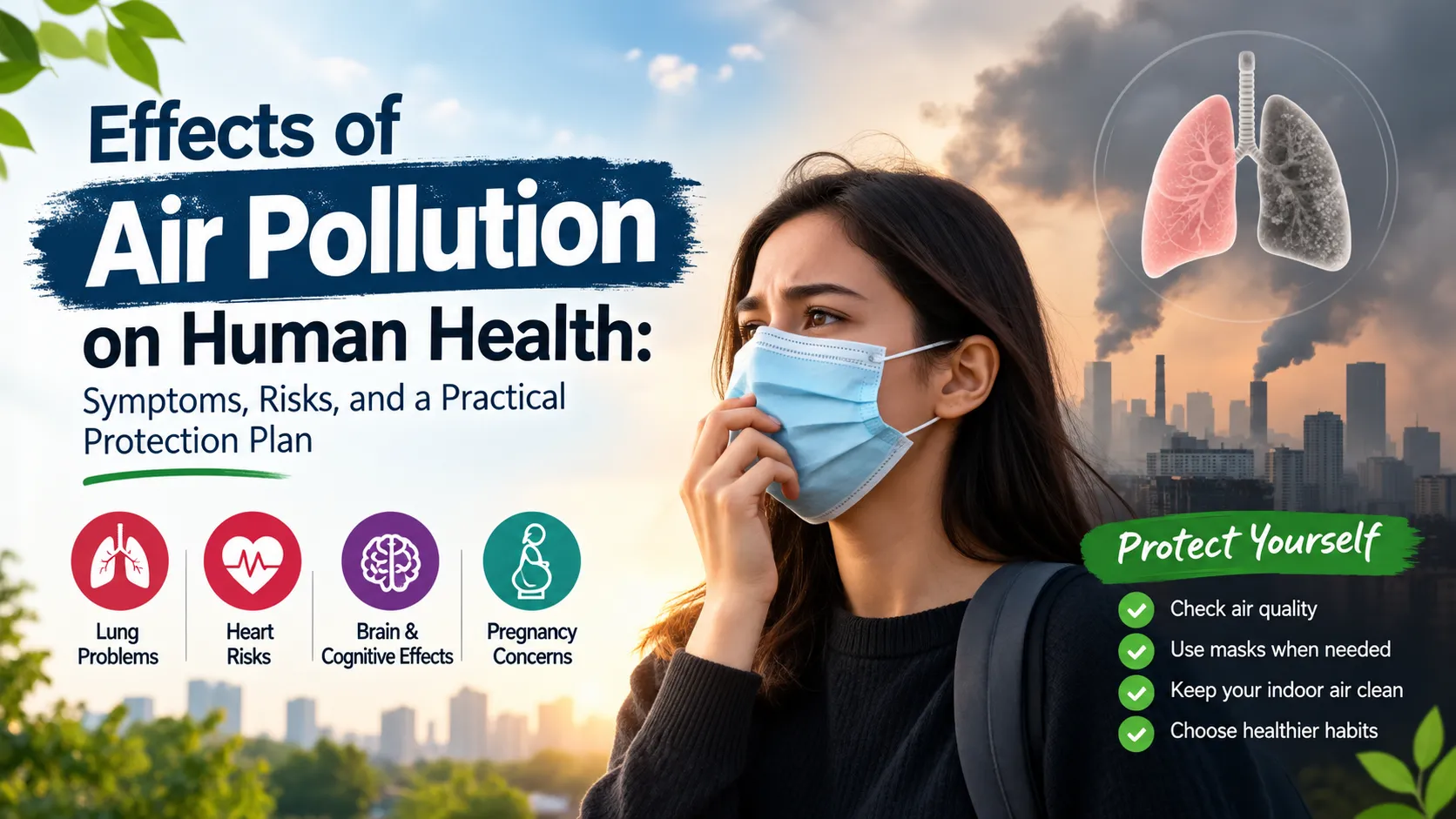
Most articles on the effects of air pollution on human health list the same five diseases and stop there. That’s not enough to actually act on. This guide goes further: it explains what each major pollutant does inside your body and why, breaks down who faces the highest risk and why, and gives you a step-by-step framework for reducing your exposure starting today. It also covers what air pollution does beyond the human body to animals, birds, plants, and even stone monuments like the Taj Mahal because understanding the full picture makes the human health risks easier to take seriously. For broader context on how outdoor conditions affect wellbeing, our Environmental Health and Public Health sections cover related ground.
Air pollution is now the second-leading global risk factor for death, behind only high blood pressure. According to the State of Global Air 2024 report from the Health Effects Institute, it was linked to 8.1 million deaths worldwide in 2021, and 99% of the global population breathes air exceeding World Health Organization guideline levels a daily exposure most people are managing without realizing it.
What Each Major Pollutant Actually Does Inside Your Body
“Air pollution” isn’t one thing. It’s a mixture of different pollutants, each with its own chemistry and its own target inside the body. Knowing which pollutant does what helps explain why a hazy day affects your lungs differently than a high-ozone afternoon affects your eyes and airways.
| Pollutant | Main Sources | What It Does in the Body |
|---|---|---|
| PM2.5 (fine particulate matter) | Vehicle exhaust, wildfire smoke, industrial burning, cooking fires | Small enough to pass through lung tissue into the bloodstream; drives heart disease, stroke, and lung cancer risk |
| PM10 (coarse particulate matter) | Dust, construction, road wear, pollen mixed with pollution | Settles in the upper airway and lungs; triggers asthma attacks and bronchitis |
| Ground-level ozone (O3) | Sunlight reacting with vehicle and industrial emissions | Irritates and inflames airway linings; reduces lung function during exertion |
| Nitrogen dioxide (NO2) | Vehicle engines, gas stoves, power plants | Inflames airways and worsens asthma; linked to childhood respiratory infections |
| Sulfur dioxide (SO2) | Coal and oil burning, industrial refineries | Irritates airways directly and forms sulfate particles and acid rain |
| Carbon monoxide (CO) | Vehicle exhaust, faulty heaters, indoor combustion | Binds to blood cells in place of oxygen, starving tissues of oxygen at high levels |
How Air Pollution Affects the Body, System by System
Lungs and Airways
This is the most direct route of exposure, and the effects of air pollution on lungs show up fastest. Fine particles inflame the airway lining, and repeated exposure thickens and scars lung tissue over years, a process called reduced lung function. Children growing up in polluted areas often reach adulthood with permanently smaller lung capacity than they otherwise would have, and the damage usually goes unnoticed until a spirometry test catches it years later.
Heart and Blood Vessels
PM2.5 particles are small enough to cross from the lungs into the bloodstream, where they inflame blood vessel walls and make blood more prone to clotting. This is why short-term pollution spikes correlate with same-week increases in heart attacks and strokes, not just long-term disease; the connection is consistent enough that cardiologists in high-pollution cities routinely factor recent air quality alerts into a patient’s history.
Brain and Cognitive Function
This is where the science has moved fastest, and where most general-audience articles are years behind. Long-term PM2.5 exposure is now associated with faster cognitive decline and higher dementia risk in older adults, with some studies linking early-life exposure to lower measured cognitive performance in children. The working theory: ultrafine particles trigger low-grade brain inflammation and may reach brain tissue directly through the olfactory nerve a newer, less-publicized risk worth factoring into any broader mental health picture, not just a lung or heart concern.
Pregnancy and Early Childhood
Exposure during pregnancy is linked to lower birth weight and preterm birth, and children in high-pollution areas show higher rates of asthma diagnosis before age five, worth a look in our Women’s Health section if you’re pregnant or planning to be. Children also breathe more air relative to their body weight than adults and spend more time outdoors during physical development, so their exposure per pound of body weight is meaningfully higher than an adult breathing the same air.
Short-Term Symptoms vs. Long-Term Disease: Know the Difference
People often only think about air pollution in terms of chronic disease, but the short-term effects matter too, especially for deciding what to do today.
- Same-day symptoms: Eye and throat irritation, coughing, shortness of breath during exercise, headache, and worsened asthma or allergy symptoms. These typically appear within hours of a high-pollution day and fade once air quality improves.
- Cumulative, long-term effects: Reduced lung function, chronic bronchitis, coronary artery disease, stroke risk, and the cognitive effects described above. These build up over years of repeated exposure and usually aren’t reversible once established.
- The mistake to avoid: Treating the absence of same-day symptoms as proof the air is “fine.” Many of the long-term risks build up from exposure levels too low to cause any noticeable symptom on a given day.
Who Faces the Highest Risk
- Children: Still-developing lungs, higher breathing rate relative to body size, more outdoor time.
- Older adults: Existing cardiovascular disease makes the heart and blood vessel effects more dangerous.
- Pregnant women: Risk extends to fetal development, not just the mother’s own health.
- People with asthma, COPD, or heart disease: Pollution acts as a direct trigger on top of an existing condition.
- Outdoor workers: Construction, agriculture, delivery, and traffic-adjacent jobs mean hours of exposure with no option to simply stay indoors.
- People living near highways, ports, or industrial zones: Baseline exposure is often two to three times higher than a few miles away, even within the same city.
Effects of Air Pollution on the Environment
The same pollutants that damage human lungs and hearts move through ecosystems and cause parallel damage to plants, animals, water, and soil. Understanding this broader picture makes it clear that air pollution is a systems problem, not just a personal health issue.
Effects of Air Pollution on Plants and Crops
Ground-level ozone is the biggest threat to plant life among common pollutants. It enters leaves through the same pores plants use to breathe (stomata) and damages the cells responsible for photosynthesis, which shows up as visible leaf stippling or bronzing and, over a season, reduced crop yield. Sulfur dioxide and nitrogen oxides contribute to acid rain, which leaches nutrients like calcium and magnesium out of soil and directly damages leaf surfaces on contact. Agricultural regions downwind of industrial zones or major highways consistently show measurably lower yields for ozone-sensitive crops like soybeans, wheat, and certain vegetables, even when nothing else about the growing conditions has changed.
Effects of Air Pollution on Animals and Birds
Birds are unusually vulnerable to air pollution because of how their respiratory systems work. Human lungs move air in and out through branching sacs shaped like clusters of grapes; bird lungs move air in one continuous direction through narrow tubes, which is more efficient for the demands of flight but also means pollutants stay in contact with lung tissue longer and reach deeper with each breath. This is part of why birds have historically served as early-warning indicators for air quality problems; the origin of the phrase “canary in a coal mine” is not just a figure of speech.
- Direct respiratory harm: Particulate matter and ground-level ozone damage bird lung tissue and reduce flight endurance, which is especially costly for species that migrate long distances.
- Behavior and migration changes: Researchers tracking geese during major wildfire smoke events recorded birds pausing migration or rerouting entirely to avoid heavy smoke, which delays breeding and feeding schedules.
- Measurable population impact: A widely cited U.S. study estimated that Clean Air Act regulations reducing ozone pollution prevented the loss of over 1.5 billion birds by protecting both their respiratory health and the insect populations many species feed on.
Larger mammals and livestock face similar cardiovascular and respiratory stress from long-term exposure, and aquatic life is affected indirectly when acid rain lowers the pH of lakes and streams, which harms fish reproduction and can wipe out sensitive species entirely. For a deeper look at bird-specific findings, the Cornell Lab of Ornithology’s research summary is a well-sourced starting point.
When Pollution Eats Away at Stone: The Taj Mahal Example
The Taj Mahal offers a rare case where air pollution’s effects are visible to the naked eye over a human lifetime, which makes it a genuinely useful way to understand what’s happening invisibly inside human lungs every day. The monument’s white marble has visibly yellowed and, in places, blackened since the 1970s, and the cause turned out to be more layered than a single pollutant.
- Acid rain corrosion: Sulfur dioxide from the nearby Mathura oil refinery and other regional industry combines with atmospheric moisture to form sulfuric acid, which slowly corrodes the marble’s surface a process Indian courts and researchers have literally termed “marble cancer.”
- Particle deposition: A study by researchers at Georgia Tech and the University of Wisconsin found that black and brown carbon particles, along with dust, physically coat the marble surface and absorb light, which is what produces the visible yellow-brown tinge.
- A more recent, less-known factor: Follow-up research has identified hydrogen sulfide gas, generated by untreated pollution in the nearby Yamuna River, as a separate contributor to surface staining, a reminder that air and water pollution often interact rather than acting in isolation.
India’s Supreme Court has treated this as a serious environmental and cultural issue since the 1990s, restricting industrial activity in the surrounding “Taj Trapezium Zone.” You can read the original court reasoning in the 1996 Supreme Court judgment. The lesson for human health is direct: if airborne sulfur compounds and carbon particles can visibly corrode solid marble over a few decades, the same particles settling in soft lung tissue every day are not a minor concern.
Effects of Air Pollution at a Glance
A quick-reference summary, organized by category, worth saving or screenshotting for later:
- On humans: Reduced lung function, asthma and COPD, heart disease and stroke, cognitive decline, pregnancy complications, higher cancer risk.
- On animals and birds: Respiratory damage, disrupted migration, reduced reproduction, population decline in sensitive species.
- On plants and crops: Leaf damage from ozone, reduced photosynthesis, lower crop yields, soil nutrient loss from acid rain.
- On water and soil: Acidification of lakes and streams, heavy metal and nutrient runoff, harm to aquatic reproduction.
- On buildings and monuments: Acid rain corrosion, particulate staining and discoloration, accelerated material decay, the Taj Mahal being the most documented example.
- On climate: Black carbon particles absorb heat and accelerate glacier and ice melt, creating a feedback loop with broader climate change.
Common Mistakes People Make Protecting Themselves
- Judging air quality by sight or smell. The most dangerous fine particles are invisible and odorless; a clear sky doesn’t mean a safe AQI.
- Wearing the wrong mask. Cloth and surgical masks block large droplets but do little against PM2.5. Only a properly fitted N95 or KN95 filters it effectively.
- Ignoring indoor air. Gas stoves, candles, and unvented fireplaces can push indoor pollutant levels above outdoor levels, even on a clean-air day.
- Exercising outdoors on poor-AQI days. Heavier breathing pulls pollutants deeper into the lungs, undoing much of the cardiovascular benefit of the workout. See our Fitness section for indoor alternatives worth rotating in on high-AQI days.
- Overestimating houseplants. The idea that houseplants meaningfully clean indoor air comes from a sealed-chamber NASA study; in a real room, a proper air purifier does the actual work.
A Practical Framework for Reducing Your Exposure
- Check your local Air Quality Index (AQI) daily, the same way you’d check the weather. Most weather apps now include it, or you can use a dedicated source like AirNow.
- Learn the AQI color bands: green and yellow are generally fine for normal activity; orange means sensitive groups should reduce prolonged outdoor exertion; red and above means everyone should limit time outdoors.
- Move hard outdoor exercise indoors on orange-or-higher AQI days, especially for children, older adults, and anyone with asthma or heart disease.
- Use a HEPA air purifier sized correctly for the room (check its stated square footage rating) rather than one undersized unit expected to cover an entire home.
- Ventilate on clean-air days and keep windows closed during smoke events or high-pollution alerts; timing matters as much as the equipment.
- Switch high-exposure habits where you can: an induction or electric stove instead of gas, and a vented range hood if gas isn’t optional.
Tools and Systems Worth Using
Reliable, real-time tracking makes every step above easier to actually follow through on:
- AirNow (EPA): The official U.S. real-time AQI source; see EPA’s Air Quality page.
- IQAir and PurpleAir: Crowd-sourced monitoring with more localized detail than government stations, useful near a highway or rail yard.
- Indoor PM2.5 monitors: An inexpensive way to confirm whether cooking or candles are pushing indoor air below outdoor quality.
Frequently Asked Questions
What are the main effects of air pollution on human health?
Reduced lung function, chronic respiratory disease, heart disease and stroke, and, based on more recent research, faster cognitive decline. Pregnant women and children face added risks around birth weight and respiratory development.
How does air pollution affect the lungs specifically?
Fine and coarse particles inflame and, with repeated exposure, scar airway tissue, gradually reducing lung capacity. Ground-level ozone adds direct irritation, which is why lung function tests in polluted areas often show declines even without a formal diagnosis.
Does air pollution affect animals and birds as much as it affects humans?
In some ways, more so; their one-directional lung airflow keeps pollutants in contact with tissue longer. Air pollution damages bird lung tissue, disrupts migration timing, and has been linked to measurable population declines.
Why is the Taj Mahal turning yellow?
A combination of sulfur dioxide-driven acid rain, black and brown carbon particle deposits, and dust settling on the marble surface. More recent research also points to hydrogen sulfide gas from pollution in the nearby Yamuna River as a contributing factor.
Can air pollution really damage plants and crops?
Yes. Ground-level ozone damages the cells plants use for photosynthesis, and acid rain strips nutrients from soil. Regions with high pollution consistently show lower yields for ozone-sensitive crops like soybeans and wheat.
What’s the single most useful habit for reducing my exposure?
Checking the local AQI daily and adjusting outdoor activity accordingly. It’s a two-second habit that directly addresses both the short-term symptom risk and, over time, the cumulative exposure that drives long-term disease.
Final Thoughts
Air pollution’s effects reach further than most people assume, from lung tissue and blood vessels to brain function, from bird migration routes to crop yields, and even into the marble of a 17th-century monument. None of that means the situation is hopeless at the individual level. Checking AQI as a daily habit, timing outdoor activity around pollution spikes, and fixing the specific sources of indoor exposure in your own home are small, concrete steps that measurably reduce both the short-term symptoms and the long-term risks described above.