

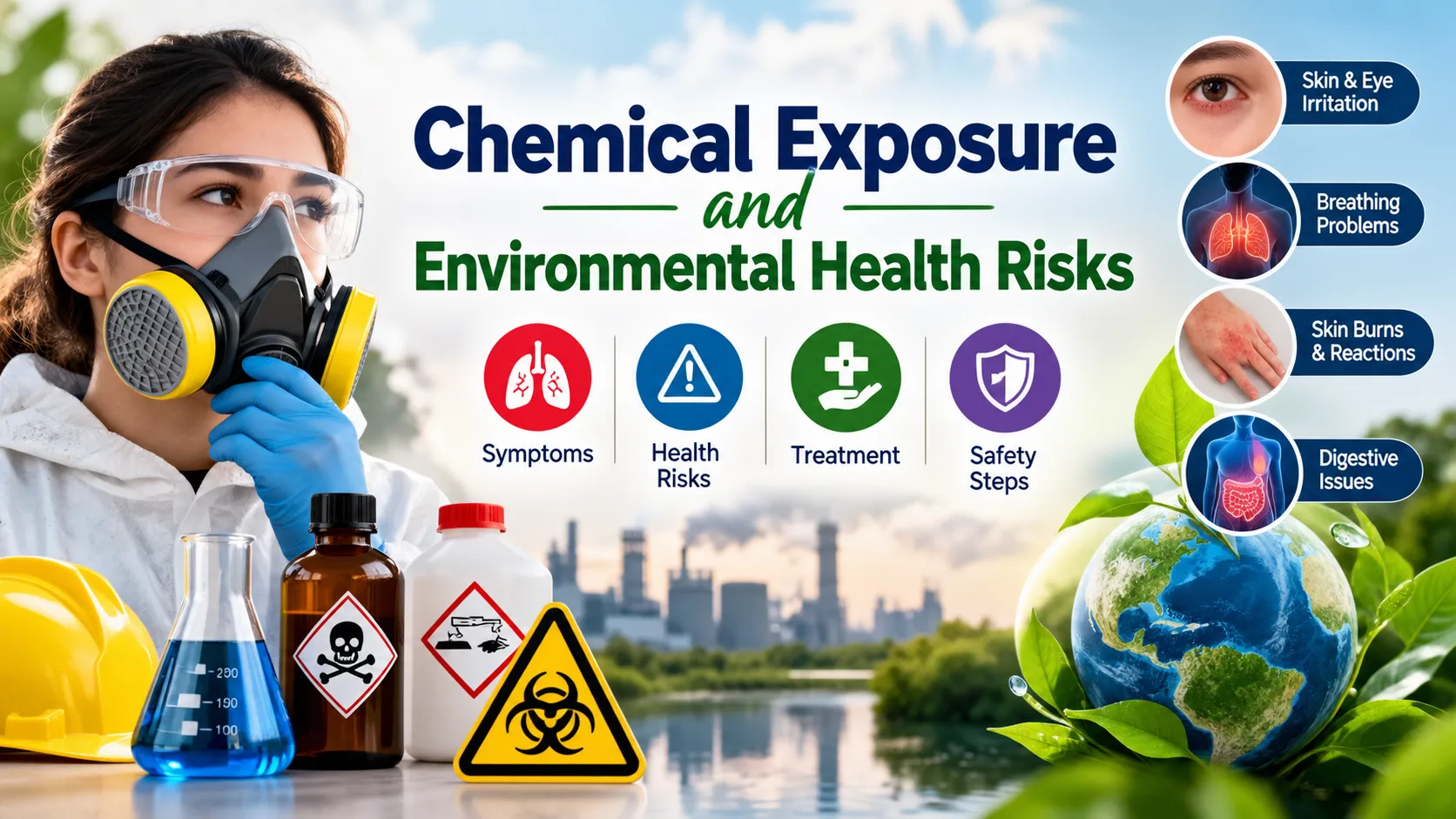
Chemical exposure and environmental health risks touch more parts of life than most people expect, from a splash in the eye at a kitchen sink to a decades-long question about a veteran’s health claim. This guide is built to answer whichever version of that question brought you here: what actually happens in the body, how it gets coded in a medical record, what to do in the first few minutes, and what your options are afterward if you’re weighing a legal claim or a VA disability rating. Nothing here replaces a doctor, a licensed attorney, or an accredited VA representative for your specific situation, but it will get you oriented fast and accurately.
What Counts as Chemical Exposure: The Four Routes
Occupational and environmental health treat chemical exposure as an entry-route problem first, because the route determines both the immediate danger and the right response.
- Inhalation: Breathing in vapors, fumes, gases, or fine particulates is the fastest route into the bloodstream for many chemicals, and the one most likely to cause emergency symptoms.
- Dermal (skin) contact: Direct contact with skin, which can cause local burns or, for certain solvents and pesticides, absorb through intact skin into systemic circulation.
- Ocular (eye) contact: A splash or vapor exposure to the eye the most time-sensitive of the four routes, since corneal damage can begin within seconds for strong acids or alkalis.
- Ingestion: Swallowing a chemical, whether through contaminated food or water, or accidental ingestion the route most associated with pediatric poisoning cases.
Chemical Exposure Symptoms by Route
- Inhalation: Coughing, throat irritation, shortness of breath, dizziness, headache, and in severe cases, chemical pneumonitis or loss of consciousness.
- Skin: Redness, burning pain, blistering, or a corrosive burn with visible tissue damage depending on the chemical’s pH and concentration.
- Eyes: Immediate pain, tearing, redness, blurred vision, and light sensitivity — worsening pain over time can indicate deeper corneal injury.
- Ingestion: Burning in the mouth and throat, nausea, vomiting, abdominal pain, and, for caustic substances, a real risk of esophageal injury.
One detail worth knowing: symptom severity doesn’t always match injury severity at first. Some corrosive chemicals cause deep tissue damage with deceptively mild initial pain, which is part of why medical evaluation matters even when a chemical splash “doesn’t feel that bad.”
Chemical Exposure ICD-10 Codes: A Quick Reference
This section is for clinicians, coders, and anyone trying to understand a diagnosis code on their own chart. It is a coding reference, not medical advice, and any real chart should be coded by a qualified clinician or coder against the current CDC/NCHS ICD-10-CM tables.
| Scenario | ICD-10-CM Code Family | Notes |
|---|---|---|
| General chemical exposure, no injury yet documented | Z77.098 (and the Z77.0– family) | Used for contact with or suspected exposure to hazardous chemicals when no resulting condition has been diagnosed |
| Chemical exposure to the eye (burn or corrosion) | T26.9– (right eye: T26.91–, left eye: T26.92–, unspecified: T26.90–) | Requires a 7th character: A for initial encounter, D for subsequent encounter, S for sequela |
| Chemical exposure to the face, head, or neck | T20.– (burn) or corresponding corrosion subcodes | Site-specific; distinct from the T26 eye-and-adnexa category |
| Chemical exposure to skin elsewhere on the body | T21–T25 by body region, or L23–L25 for irritant/allergic contact dermatitis | Code choice depends on whether the presentation is a chemical burn or a dermatitis reaction |
| Toxic effect of a specific substance (systemic) | T51–T65, by substance category (solvents, corrosives, metals, pesticides, gases, etc.) | Used when the concern is the chemical’s toxic effect rather than a localized burn |
A practical note most articles skip: Z77.098 and the T-codes aren’t interchangeable. Z-codes document exposure or contact with no confirmed injury; T-codes document an actual diagnosed burn, corrosion, or toxic effect. Using the wrong category is a common source of claim denials in medical billing.
Chemical Exposure to the Eyes: What to Do in the First Few Minutes
- Flush the eye immediately with clean, lukewarm water or sterile saline for at least 15 to 20 minutes, holding the eyelid open this matters more than any other single step.
- Remove contact lenses as soon as flushing starts, if it can be done without delaying irrigation.
- Don’t rub the eye and don’t apply any neutralizing substance water or saline is the standard, and “neutralizing” an acid with a base (or vice versa) can generate heat that worsens the injury.
- Continue flushing on the way to care if possible, and seek emergency evaluation for any chemical eye exposure beyond a mild, brief irritant this is not a wait-and-see injury.
- If you’re at a workplace with an ANSI Z358.1-compliant eyewash station, use it immediately rather than walking to a bathroom sink; those stations are designed for sustained, hands-free flushing. Afterward, our Doctors section can help you think through when a follow-up visit is worth scheduling.
Chemical Exposure Treatment Beyond the Eye
- Skin exposure: Remove contaminated clothing and jewelry, flush the affected area with water for at least 15 to 20 minutes, and seek care for any burn beyond minor redness.
- Inhalation exposure: Move to fresh air immediately, loosen tight clothing, and seek emergency care for any breathing difficulty, chest tightness, or persistent coughing.
- Ingestion exposure: Call Poison Control (1-800-222-1222 in the U.S.) before inducing vomiting or giving anything by mouth some chemicals cause more damage coming back up than staying down.
- When to call 911 instead of driving yourself: Difficulty breathing, loss of consciousness, a large-surface-area burn, or any eye exposure to a strong acid or alkali.
Chemical Exposure Limits: The Confusing Truth About “Safe” Levels
This is a genuinely underexplained corner of the topic. Workplace chemical exposure limits come from three different sources, and they don’t agree with each other nearly as often as people assume.
- OSHA’s Permissible Exposure Limits (PELs): The only legally enforceable limit, but most current PELs are still the values OSHA adopted in 1971 from even older data. A 1989 attempt to update hundreds of them was struck down in court in 1992, and most have never been revised since.
- NIOSH’s Recommended Exposure Limits (RELs): Science-based recommendations from the CDC’s occupational safety research arm, generally more current and more protective than OSHA’s PELs but not legally enforceable on their own.
- ACGIH’s Threshold Limit Values (TLVs): Guidelines from a private scientific association, regularly updated, often the most conservative of the three also not legally enforceable.
The practical upshot: a workplace can be fully legal under OSHA’s enforceable PEL for a given chemical while still exceeding the more current NIOSH or ACGIH guidance. If you’re evaluating whether a workplace exposure was actually safe, the PEL alone doesn’t settle that question.
Chemical Exposure and Environmental Health: Beyond the Individual Incident
Environmental health looks at chemical exposure at the community level, not just the individual incident and cumulative exposure to multiple chemicals from multiple sources is a growing focus. The Environmental Defense Fund’s Chemical Exposure Action Map is a genuinely useful public tool here: it visualizes releases of high-priority chemicals by facility and community, mapped against health outcomes like cancer, asthma, and developmental harm, and lets you check what’s being released near a specific address. For broader context on how environmental exposures shape long-term health, our Environmental Health and Public Health sections cover related ground.
When to Consult a Chemical Exposure Lawyer or Attorney
This is general information, not legal advice for any specific situation, a licensed attorney in your jurisdiction is the right source of guidance. That said, a few patterns are worth knowing before that conversation.
- Workers’ compensation vs. third-party claims: A workplace chemical exposure usually falls under workers’ comp first, but if a third party (a chemical manufacturer, a contractor, a property owner) contributed to the exposure, a separate claim may be possible alongside it.
- Documentation matters more than memory: Safety data sheets (SDS) for the chemical involved, incident reports, medical records with the specific ICD-10 codes assigned, and witness names are the foundation of most successful cases.
- Statutes of limitations vary by state and by claim type: Some toxic exposure cases involve a “discovery rule” that starts the clock when the injury was discovered rather than when exposure occurred, which matters for conditions with long latency periods.
- A free consultation is genuinely low-risk: Most attorneys handling chemical exposure and toxic tort cases work on contingency and offer a free initial case review, which is a reasonable way to find out if a claim is worth pursuing before committing to anything.
Chemical Exposure and VA Disability: What Veterans Should Know
Veterans exposed to burn pits, Agent Orange, or other airborne hazards during service have real, established options under the PACT Act, which added more than 20 presumptive conditions covering respiratory diseases and several categories of cancer. A presumptive condition means the VA automatically assumes your service caused it if you served in a qualifying location and time period, without requiring you to separately prove the connection a meaningfully lower bar than a standard direct-service-connection claim.
- Get the toxic exposure screening: Every veteran enrolled in VA health care is entitled to one, and while it’s not required to file a claim, it creates a documented record that can support one.
- Check the presumptive list before assuming you need to prove causation: If your condition and service location match the presumptive criteria, the claims process is substantially simpler than a standard claim.
- Consider an accredited representative: Veterans Service Organizations (VSOs) offer free, accredited help filing PACT Act claims, and using one costs nothing.
This is general information, not a guarantee of eligibility or outcome the current presumptive list and eligible service locations should always be checked directly against VA.gov, since both have been updated multiple times since the PACT Act passed.
Common Mistakes People Make After a Chemical Exposure
- Flushing for too short a time. A quick rinse under the tap often falls well short of the 15-to-20-minute standard, especially for eye exposures.
- Trying to neutralize instead of dilute. Mixing an acid and a base at the exposure site can generate heat and worsen tissue damage water is the standard response, not a counter-chemical.
- Throwing away contaminated clothing or the chemical container. Both can matter later for medical treatment decisions and for any workers’ comp or legal claim bag and keep them if it’s safe to do so.
- Assuming mild initial pain means a minor injury. Some of the most serious chemical burns start with deceptively mild sensation before worsening over hours.
- Waiting to see a doctor because symptoms improved. Delayed-onset symptoms are common with certain inhalation exposures, and an evaluation on the day of exposure creates the medical record that matters most for any later claim.
A Practical Framework for After Any Chemical Exposure
- Stop the exposure first: move away from the source, remove contaminated clothing, or flush the affected area don’t pause to look up information before doing this.
- Flush with water for the full 15 to 20 minutes for skin or eye exposure, even if pain seems to be easing sooner.
- Seek medical evaluation the same day, even for exposures that seem mild, so the injury and its ICD-10 code are documented while they’re fresh.
- Photograph the injury, the chemical container or label, and the location, if you’re able to safely do so.
- Request a copy of the safety data sheet (SDS) for the chemical involved workplaces are required to make these available.
- Keep a written timeline: what happened, when, who was present, and what symptoms appeared and when.
- If it happened at work or involves a veteran’s service history, start the workers’ comp, VA screening, or legal consultation process within days, not months some of these processes have real time limits.
Frequently Asked Questions
What is the ICD-10 code for chemical exposure to the eye?
Chemical burns and corrosion to the eye fall under the T26 category, with laterality codes T26.91 for the right eye, T26.92 for the left eye, and T26.90 when unspecified, plus a required 7th character for initial encounter, subsequent encounter, or sequela.
What are the main symptoms of chemical exposure?
Symptoms depend on the route: coughing and breathing difficulty for inhalation, burning and blistering for skin contact, pain and tearing for eye exposure, and burning or nausea for ingestion. Severity can worsen over hours even when initial symptoms seem mild.
What are the four main routes of chemical exposure?
Inhalation, dermal (skin) contact, ocular (eye) contact, and ingestion. Each has a different typical onset speed and a different first-response protocol.
Do I need a chemical exposure lawyer?
It depends on the circumstances workplace exposures often start with workers’ compensation, while exposure involving a negligent third party may support a separate claim. A free consultation with an attorney experienced in toxic exposure cases is a low-risk way to find out, though this isn’t a substitute for individualized legal advice.
How does VA disability work for chemical exposure?
Veterans with a presumptive condition under the PACT Act and qualifying service history don’t need to separately prove their condition was caused by service the connection is automatically presumed. Conditions and eligible locations should be checked directly on VA.gov, since the list has been updated since the law passed.
Final Thoughts
Chemical exposure sits at the intersection of emergency medicine, occupational safety, environmental health, and for many people a legal or VA disability process that starts the moment the exposure happens. Flushing immediately, documenting everything, and getting evaluated the same day protect both your health and any claim you may need to make later. The rest which ICD-10 code applies, which exposure limit actually governs a workplace, whether a case is worth pursuing is easier to navigate once you know the right questions to bring to a doctor, an attorney, or an accredited VA representative.