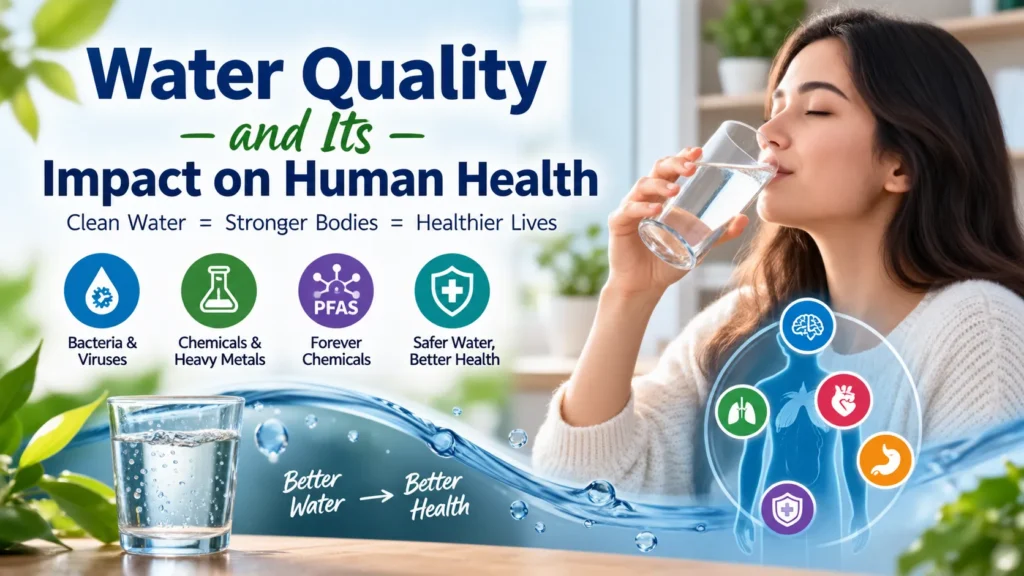


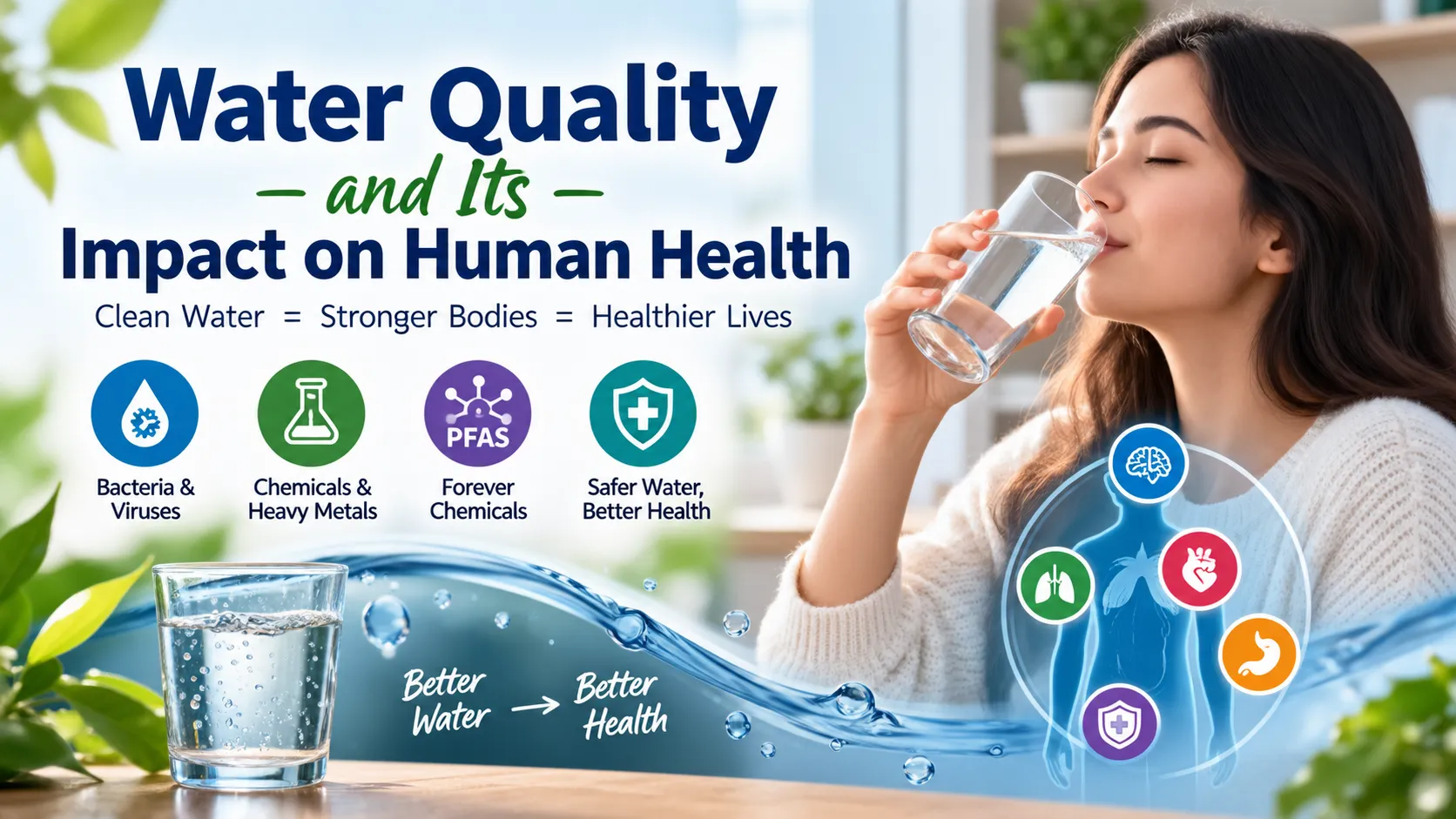
Water quality and its impact on human health are usually explained as one topic, but it’s really two very different problems wearing the same name. One kind of contamination makes people sick within hours. The other builds up quietly for years before anything shows up on a test. Treating them the same way is why so many households fix the wrong risk first. This guide breaks the two apart, covers what heavy metals and modern chemicals like PFAS specifically do in the body, walks through a real water crisis to show how these risks actually unfold, and ends with a step-by-step framework for checking and improving your own water.
The scale here is real: unsafe water, sanitation, and hygiene still drive at least 1.4 million preventable deaths every year, according to the World Health Organization. For a broader look at how environmental exposures shape health outcomes, our Environmental Health section covers related ground.
Two Very Different Water Quality Problems
Most articles list waterborne diseases and toxic chemicals in the same breath. That’s misleading, because the two demand completely different responses.
Biological Contamination: Fast and Obvious
Bacteria, viruses, and parasites, such as E. coli, cholera, typhoid, and giardia, cause acute illness, usually within hours to a few days. Symptoms are unmistakable: vomiting, diarrhea, fever, dehydration. This is the dominant water quality risk in areas without reliable treatment and sanitation infrastructure, and it’s the reason boiling water is standard emergency advice.
Chemical and Heavy Metal Contamination: Slow and Invisible
Heavy metals, industrial chemicals, and agricultural runoff rarely cause a same-day symptom. They build up in the body over months or years, and boiling water does absolutely nothing to remove them; in fact, boiling can concentrate some chemicals as the water evaporates. This is the category most people underestimate, because a clear glass of water that tastes fine can still carry a meaningful long-term risk.
Heavy Metals in Water and Their Impact on Human Health
Heavy metal contamination is one of the most researched and most misunderstood water quality risks, partly because the health effects differ sharply by metal.
| Contaminant | Common Source | Health Effect |
|---|---|---|
| Lead | Aging lead pipes and solder, especially after a water source change | Irreversible neurological damage in children; lower IQ, attention problems |
| Arsenic | Natural groundwater deposits, agricultural runoff | Strongly linked to skin, lung, and bladder cancer with long-term exposure |
| Cadmium | Industrial discharge, some fertilizers | Kidney damage and bone demineralization |
| Mercury | Industrial waste, mining runoff | Nervous system and kidney damage |
| Aluminum | Water treatment chemicals, natural deposits | A 2025 clinical review linked elevated exposure to increased dementia and Alzheimer’s risk — a newer finding most water-quality articles still leave out |
That aluminum-dementia connection comes from a 2025 clinical review analyzing health outcomes in households sharing the same water supply a research design that isolates water quality specifically, rather than lifestyle factors that usually muddy this kind of study.
PFAS: The Newest Chemical Threat, and a Regulation Still in Motion
PFAS, or “forever chemicals,” don’t break down in the environment and accumulate in the body over time. In 2024, the EPA set the first enforceable national limits on six common PFAS compounds, citing links to cancer, liver damage, high cholesterol, and developmental harm in children a rule expected to reduce exposure for over 100 million Americans.
Worth knowing if you’re researching this in 2026: the regulatory picture has since shifted. In 2025, the EPA moved to rescind limits on four of the six regulated PFAS chemicals while extending the compliance deadline for the remaining two. This is a genuinely live policy area, not a settled fact worth checking your local water utility’s current compliance status rather than assuming last year’s news still applies.
How Contaminated Water Affects the Body
- Digestive system: The most immediate effect of biological contamination is vomiting, diarrhea, and dehydration severe enough to be fatal in young children without treatment.
- Nervous system and brain: Lead, mercury, and aluminum all interfere with brain development and function, with children facing irreversible effects even at low exposure levels.
- Kidneys and liver: Cadmium and PFAS both accumulate in these organs over years, with cadmium specifically linked to bone demineralization alongside kidney damage.
- Cancer risk: Arsenic and several PFAS compounds are established or probable human carcinogens, with risk driven by cumulative exposure rather than a single high dose.
- Pregnancy and childhood development: Lead crosses from a mother’s bones into a developing fetus, and PFAS exposure is linked to low birth weight worth a look in our Women’s Health section if you’re pregnant or planning to be.
When Water Quality Becomes a Crisis: The Flint, Michigan Example
Flint offers the clearest real-world lesson in how a single overlooked engineering step turns a cost-saving decision into a public health emergency.
- What happened: In 2014, Flint switched its water source to save money, but the more corrosive Flint River water was not treated with the corrosion inhibitors used for the previous supply.
- Why it mattered: Without that treatment step, lead leached directly from aging pipes into tap water across the city, at levels measured hundreds of times above the EPA’s action threshold in some homes.
- The human cost: More than 8,000 children were exposed to dangerous lead levels, and the CDC has noted that lead’s neurological effects are considered irreversible.
The lesson isn’t just about Flint specifically; it’s that water quality failures often trace back to one missed procedural step, not a dramatic single event. You can read a detailed ten-years-later assessment of the health outcomes from Science News Explores.
Water Pollution’s Impact on Human Health and the Environment
Water contamination rarely stays contained to what comes out of a tap. The same pollutants move through the wider environment and loop back toward human exposure in less direct ways.
- Aquatic ecosystems: Nutrient runoff from agriculture triggers algal blooms that deplete oxygen and kill fish populations, some of which produce toxins that make affected water unsafe even for swimming.
- The food chain: Mercury and other heavy metals bioaccumulate up the food chain, which is why fish from contaminated waters carry a meaningfully higher metal load than the water itself.
- Agricultural soil: Irrigation with contaminated water introduces heavy metals into crops, creating a second exposure route beyond drinking water alone.
Who Faces the Highest Risk
- Children and pregnant women: Lead and PFAS both cross into fetal development, and children absorb a higher proportion of ingested lead than adults.
- People on private well water: Wells aren’t covered by municipal testing requirements, so contamination can go undetected for years without owner-initiated testing.
- Residents of older housing or infrastructure: Lead pipes and solder installed before the 1980s remain a live risk anywhere corrosion control lapses.
- Communities near industrial or agricultural runoff: Geography, not just plumbing age, drives a meaningful share of chemical contamination risk.
Common Mistakes People Make About Water Quality
- Assuming municipal water is automatically safe. City water is regulated and generally safer than untested sources, but the Flint case shows regulation doesn’t prevent every failure; checking your utility’s annual water quality report is still worth the ten minutes.
- Assuming bottled water is automatically better. Bottled water is regulated less strictly than tap water in most countries, and some brands have tested positive for PFAS and microplastics.
- Boiling water to remove chemical contamination. Boiling kills biological contaminants effectively but does nothing for lead, arsenic, or PFAS, and can even concentrate some chemicals as water evaporates.
- Buying a filter without checking what it actually removes. A basic carbon pitcher filter improves taste and removes some chlorine byproducts, but only reverse osmosis or specific NSF-certified filters remove heavy metals and PFAS.
- Never test a private well. Well owners are their own regulator; skipping annual testing means contamination can build for years with no warning sign at all.
A Practical Framework for Checking and Improving Your Water
- Get your municipal water quality report (often called a Consumer Confidence Report). Utilities are required to publish one annually, and it lists exactly what’s been detected and at what level.
- If you’re on a private well, test it at least once a year for bacteria, and every few years for heavy metals, nitrates, and any locally known contaminants.
- Match your filter to the actual contaminant: carbon filters for taste and chlorine, reverse osmosis for heavy metals and most PFAS, and look for NSF/ANSI certification numbers specific to the contaminant you’re targeting.
- If your home has older plumbing, run the cold tap for 30 to 60 seconds before drinking or cooking with it, especially after water has sat in pipes overnight.
- Never use hot tap water for cooking or infant formula; hot water leaches lead from pipes faster than cold.
- During a boil-water advisory, remember boiling addresses biological contamination only; check separately whether the advisory also flags a chemical issue.
- If you’re pregnant, have young children, or manage a household with a compromised immune system, treat well-water testing and filter maintenance as a health task, not a home-improvement one. Our Doctors section can help you think through when a specific exposure is worth a professional check-in.
Water Pollution and Its Impact on Human Health, In Brief
A quick-reference summary worth saving for a presentation, report, or quick recap:
- Biological contamination: Fast-acting illness, diarrhea, vomiting, and dehydration from bacteria, viruses, and parasites.
- Heavy metals: Slow-building damage to the brain, kidneys, and cardiovascular system; lead, arsenic, cadmium, mercury, and aluminum are the main concerns.
- PFAS and industrial chemicals: Linked to cancer, liver damage, and developmental harm; regulation is still actively evolving.
- Environmental spillover: Aquatic ecosystem damage, food chain bioaccumulation, and contaminated irrigation water extend the health impact beyond drinking water alone.
- Highest-risk groups: Children, pregnant women, private well users, and residents of older housing infrastructure.
Frequently Asked Questions
How does water quality affect human health?
Poor water quality causes two very different problems: fast-acting illness from biological contaminants like bacteria and parasites, and slow-building damage from chemicals and heavy metals like lead, arsenic, and PFAS that accumulate over years.
What is the impact of water pollution on human health and the environment?
Beyond direct health effects like organ damage and cancer risk, contaminated water damages aquatic ecosystems, allows heavy metals to bioaccumulate up the food chain into fish, and can contaminate crops through irrigation, extending the health impact well past drinking water alone.
Which heavy metals in water are most dangerous to human health?
Lead, arsenic, cadmium, and mercury are the most studied and regulated. Lead causes irreversible neurological harm in children, arsenic is strongly linked to cancer, cadmium damages kidneys and bones, and mercury affects the nervous system; aluminum’s link to dementia risk is a newer, less publicized concern.
Is boiling water enough to make it safe to drink?
Only against biological contaminants. Boiling kills bacteria, viruses, and parasites effectively, but it does nothing to remove lead, arsenic, PFAS, or other chemical contaminants, and can even concentrate some of them as water evaporates.
How do I know if my water quality is a public health concern in my area?
Check your municipal utility’s annual Consumer Confidence Report, or test your water directly if you’re on a private well; both are required, and public information is available in most regions, and neither takes more than a few minutes to request.
Final Thoughts
Water quality and its impact on human health isn’t one risk; it’s at least two, and they need different responses. Biological contamination calls for boiling and sanitation; heavy metals and chemicals call for the right filter and regular testing, not boiling. Flint showed how quickly one skipped step can turn into a decades-long health crisis, and PFAS shows the science and the regulation are still catching up in real time. Checking your water quality report and matching your filter to what’s actually in your water are two concrete steps that address both problems at once.