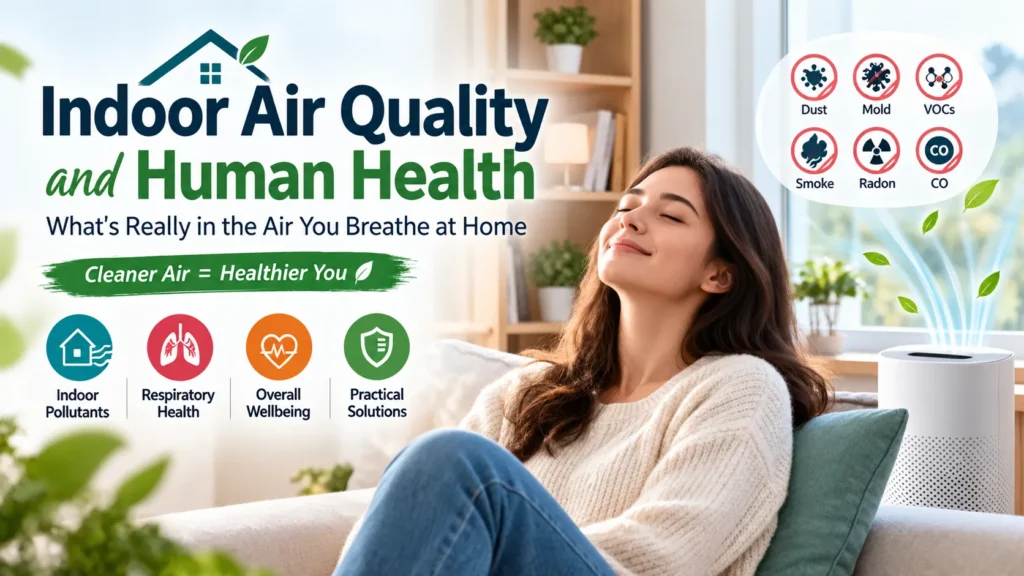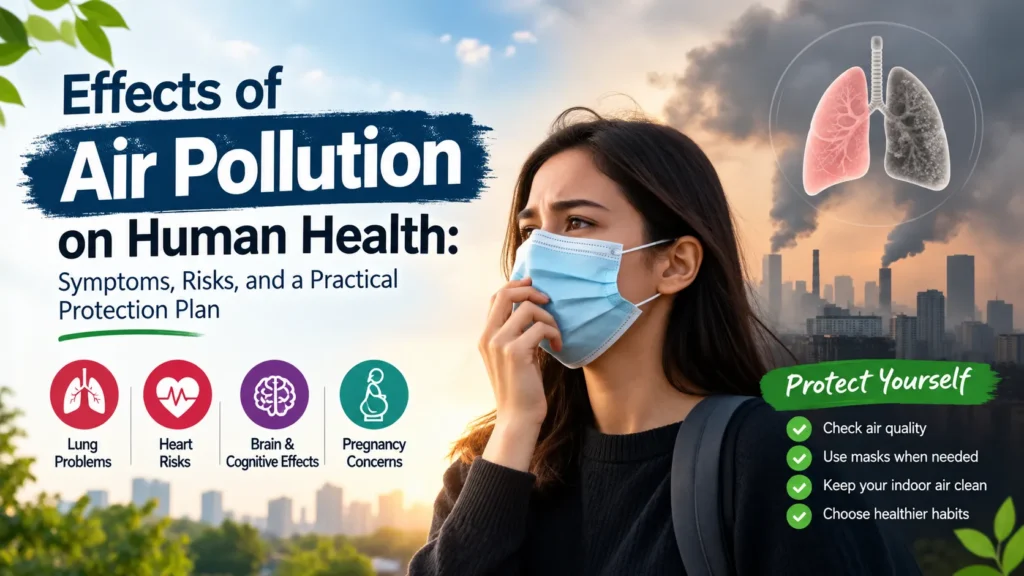


Most people picture air pollution as something that happens outside: traffic, smog, factory smoke. In reality, indoor air quality and human health are more tightly linked than outdoor air for one simple reason: the EPA estimates people spend roughly 90% of their time indoors, and indoor pollutant concentrations regularly run two to five times higher than outdoors. This guide covers what’s actually driving that gap, how fire and smoke specifically affect the air inside a home, who’s most at risk, and a practical, step-by-step framework for fixing it not just a list of definitions. For broader context on how the spaces around you affect wellbeing, our Environmental Health section covers related ground.
Indoor air pollution is also a bigger public health issue globally than most people realize. The World Health Organization estimates household air pollution caused 2.9 million deaths in 2021 alone, and combined with outdoor air pollution, the two are linked to 6.7 million premature deaths a year. This isn’t a niche wellness topic; it’s a measurable driver of global disease burden, and understanding it is worth treating with the same seriousness as diet or exercise.
Why Indoor Air Quality Deserves a Public Health Perspective, Not Just a Personal One
It’s easy to treat indoor air pollution as a private, fixable inconvenience: open a window, buy a candle, move on. Viewed from a public health perspective, it looks different. Indoor air pollution exposure is not evenly distributed: it tracks closely with income, housing quality, and geography, a pattern our Public Health section touches on from a broader population-health angle.
- Housing quality drives exposure. Older homes with poor ventilation, aging HVAC systems, and deferred maintenance trap pollutants at higher concentrations than newer, well-ventilated housing, and lower-income renters have the least ability to fix ventilation or replace old appliances.
- Energy poverty compounds the problem globally. Roughly 2.1 billion people worldwide still cook with open fires or inefficient stoves burning wood, coal, or dung, which is why household air pollution remains one of the leading environmental causes of death, concentrated almost entirely in low- and middle-income countries.
- Building codes and ventilation standards are public health tools. Standards like ASHRAE 62.1 (commercial buildings) and updated residential codes exist specifically because ventilation rates measurably change population-level asthma and respiratory illness rates; this is regulatory science, not just an engineering preference.
The practical takeaway: individual fixes like air purifiers matter, but indoor air quality is also a policy and infrastructure issue, especially for renters, older housing stock, and lower-income households worldwide.
The Pollutants Actually Living in Your Home
“Indoor air pollution” covers a wider mix of contaminants than most people expect, and each one affects the body differently.
| Pollutant | Common Indoor Sources | Health Effect |
|---|---|---|
| Radon | Soil gas seeping through foundation cracks | Leading cause of lung cancer among non-smokers; second overall after smoking |
| Volatile organic compounds (VOCs) | Paints, new furniture, cleaning products, air fresheners | Eye/throat irritation short-term; liver, kidney, and nervous system effects with chronic exposure |
| Mold and dampness | Leaks, poor humidity control, bathrooms without ventilation | Triggers asthma and allergic reactions; some species produce toxins with broader health effects |
| PM2.5 and combustion particles | Gas stoves, fireplaces, candles, tobacco smoke, wildfire infiltration | Penetrates deep into lungs and bloodstream; linked to asthma, heart disease, and reduced lung function |
| Carbon monoxide (CO) | Faulty furnaces, unvented heaters, attached garages | Colorless and odorless; interferes with oxygen delivery and can be fatal at high concentrations |
| Dust mites and pet allergens | Carpets, bedding, upholstered furniture | Common trigger for asthma and allergic rhinitis, especially in children |
One detail most articles skip: VOC concentrations are consistently 2 to 10 times higher indoors than outdoors, and can spike to over 1,000 times outdoor levels for several hours right after activities like paint stripping. A freshly renovated room can have worse air quality than a busy street outside.
How Fire Can Affect Indoor Air Quality and Human Health
Fire’s effect on indoor air quality goes well beyond an obvious house fire, and the details here are more specific and more useful than the generic “smoke is bad for you” advice most articles stop at.
Wildfire Smoke Doesn’t Stop at a Closed Window
A well-known piece of public health advice during wildfire smoke events is to close windows and stay inside. Research from the University of California, Berkeley found this genuinely helps, but only partially: homes that closed windows and ran air filtration cut indoor PM2.5 by about half compared to doing nothing, yet indoor particulate levels still measured roughly three times higher on wildfire smoke days than on clean-air days in the same homes. The smallest particles infiltrate through gaps most people never think to seal around window frames, exterior outlets, and HVAC intakes, which is why filtration matters as much as sealing doors and windows.
Smoke Lingers Long After the Fire Is Out
This is a genuinely underreported finding: research published in Science Advances by Colorado State University showed that wildfire smoke compounds attach to indoor surfaces carpet, drapes, countertops and continue off-gassing back into the air for days or weeks after the smoke outside has cleared. Running an air purifier during the event isn’t enough on its own; the researchers found that simple surface cleaning (vacuuming, dusting, mopping) meaningfully cuts this lingering exposure, a step most public health messaging leaves out entirely.
Everyday Indoor Fire Sources Do a Smaller Version of the Same Thing
You don’t need a wildfire nearby to get fire-related indoor air pollution. Fireplaces, wood stoves, gas stoves, candles, and incense all produce the same category of combustion particles and gases, just at a smaller, chronic scale rather than one dramatic event. A household that burns a fireplace regularly through winter without a well-maintained flue and adequate ventilation is running a low-grade version of a wildfire smoke event, every time, indoors.
Short-Term Symptoms vs. Long-Term Health Effects
- Same-day symptoms: Headaches, dizziness, eye and throat irritation, fatigue, and worsened allergy or asthma symptoms sometimes grouped under “sick building syndrome” when they consistently appear in one specific building and improve once someone leaves it.
- Long-term effects: Chronic respiratory disease, increased cardiovascular risk, and, with high radon exposure specifically, lung cancer that can take years to develop after exposure.
- The mistake to avoid: Assuming a building is “fine” because no one has gotten obviously sick. Radon and long-term VOC or PM2.5 exposure build risk with no early warning symptoms at all.
Who Faces the Highest Risk Indoors
- Children: Higher breathing rate relative to body size, and more time spent close to the floor where heavier particles and allergens settle.
- Older adults and people with asthma, COPD, or heart disease: Indoor pollutants act as a direct trigger on top of existing vulnerability.
- People in older or poorly maintained housing: Outdated HVAC systems, unaddressed mold, and lack of mechanical ventilation compound exposure.
- Households relying on solid fuel for cooking or heating: The population bearing the overwhelming majority of the global household air pollution death toll, concentrated in low- and middle-income countries.
- Anyone during or after a wildfire smoke event: As covered above, indoor exposure during these events is a real, measurable health risk, not a false alarm.
Common Mistakes People Make With Indoor Air Quality
- Masking odors instead of removing sources. Scented candles and air fresheners cover a smell without removing the VOCs or particles causing it, and many air fresheners are themselves a meaningful VOC source.
- Sealing a home tightly without adding ventilation. Energy-efficient renovations that seal drafts are great for utility bills but can trap pollutants indoors at higher concentrations if mechanical ventilation isn’t added at the same time.
- Assuming an air conditioner filters out gases. Standard AC and furnace filters catch particles, not gases like VOCs, radon, or carbon monoxide; a HEPA filter helps with the former; it does nothing for the latter.
- Skipping radon testing entirely. Radon is invisible, odorless, and unrelated to how “clean” a home looks, which is exactly why most homeowners never test for it despite it being the second-leading cause of lung cancer overall.
- Forgetting HVAC filters. A clogged filter both recirculates trapped particles and forces the system to work harder, and most manufacturer-recommended change schedules (every 1 to 3 months) are widely ignored.
A Practical Framework for Improving Your Indoor Air Quality
- Test for radon first. It’s inexpensive, it’s the single highest-stakes indoor pollutant for long-term health, and most homes have never been tested.
- Install and test carbon monoxide and smoke alarms on every level of the home, and replace batteries on a fixed schedule rather than waiting for a low-battery chirp.
- Control the source before adding filtration: fix leaks and address mold before running a purifier, switch to low-VOC paints and cleaning products, and vent gas stoves to the outside where possible.
- Ventilate strategically: open windows on clean-air days for a genuine air exchange, and close them during wildfire smoke events or high outdoor pollution days.
- Size a HEPA air purifier to the actual square footage of the room it’s in; an undersized unit running constantly does less than a correctly sized one.
- Change HVAC filters on the schedule the manufacturer recommends, and consider a higher MERV-rated filter if your system supports it.
- Keep indoor humidity between 30 and 50 percent to discourage mold and dust mites without drying out airways.
- During a wildfire smoke event, close windows, run filtration, and once the smoke clears, vacuum with a HEPA vacuum and wipe down surfaces rather than assuming the air alone needs attention.
Tools and Systems Worth Using
- Radon test kits: Inexpensive short-term kits are widely available and are the standard first step recommended by every major health agency covering indoor air.
- Indoor PM2.5 and CO2 monitors: A standalone sensor removes the guesswork about whether cooking, candles, or poor ventilation are quietly degrading air quality between visible symptoms.
- HVAC filter reminders: A simple recurring calendar reminder solves the single most commonly skipped maintenance task in home air quality.
If allergy, asthma, or unexplained headache symptoms consistently improve when you leave a specific building, that pattern is worth raising directly with a professional. Our Doctors section can help you think through when and how to bring it up.
Frequently Asked Questions
What is indoor air quality and why does it matter for human health?
Indoor air quality refers to the condition of the air inside homes, schools, and workplaces, and it matters because people spend about 90% of their time indoors, often breathing air with pollutant concentrations two to five times higher than outdoors.
What are the main health effects of indoor air pollution?
Short-term effects include headaches, irritation, and worsened asthma or allergy symptoms. Long-term effects include chronic respiratory disease, cardiovascular risk, and, with radon specifically, lung cancer.
Can fires affect indoor air quality even after the smoke clears?
Yes. Research shows wildfire smoke compounds can attach to indoor surfaces like carpet and drapes and continue releasing back into the air for days or weeks, which is why surface cleaning after a smoke event matters as much as air filtration during it.
Is indoor air pollution a personal issue or a public health issue?
Both. Individual choices like ventilation and filtration matter, but exposure is also shaped by housing quality, income, and, globally, access to clean cooking fuel, which is why public health agencies treat it as a policy issue, not just a personal one.
How do I know if my home has poor indoor air quality?
Watch for symptoms that improve when you leave the building, test specifically for radon and carbon monoxide since both are undetectable by smell, and consider an indoor air quality monitor if allergy or respiratory symptoms are frequent without an obvious cause.
Final Thoughts
Indoor air quality gets far less attention than outdoor air pollution, despite the exposure being larger for most people most of the time. The good news is that it responds well to specific, practical action: testing for radon, fixing ventilation instead of just masking odors, sizing filtration correctly, and treating a wildfire smoke event as something that needs cleanup even after the air outside looks clear again. None of this requires guesswork once you know what to test for and what to fix first.